Advertisements
Advertisements
प्रश्न
Three resistors of 6Ω, 3Ω and 2Ω are connected together so that their total resistance is greater than 6Ω but less than 8Ω Draw a diagram to show this arrangement and calculate its total resistance.
Advertisements
उत्तर
We connect the resistance of 3 Ω and 2 Ω in parallel to each other and then connect this (parallel combination) to the 6 Ω resistance in series. The required arrangement is as shown in given figure. The equivalent resistance of 3Ω and 2 Ω in parallel.
`1/"R" = 1/3 + 1/2 = (2 + 3)/6 = 5/6`
or R = `6/5`Ω = 1.2 Ω
Thus, the total resistance of the set up is (1.2 + 6) Ω = 7.2 Ω
संबंधित प्रश्न
The substance having infinitely high electrical resistance is called:
(a) conductor
(b) resistor
(c) superconductor
(d) insulator
Write down an expression for the resistance of a metallic wire in terms of the resistivity.
The diagram below shows part of a circuit:
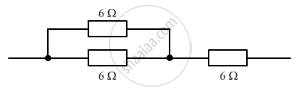
If this arrangement of three resistors was to be replaced by a single resistor, its resistance should be:
(a) 9 Ω
(b) 4 Ω
(c) 6 Ω
(d) 18 Ω
In series combination of resistances ______.
When do you say that the resistors are connected in this way? Draw a circuit diagram.
State the effect of rise in temperature on the resistance of semi-conductors.
In the circuit shown below, calculate the equivalent resistance between the points (i) A and B, (ii) C and D.
Two wires of same material and same lengths have radii in the ratio of 2 : 3, Compare their resistances.
If R1 and R2 be the resistance of the filament of 40 W and 60 W respectively operating 220 V, then:
