Advertisements
Advertisements
प्रश्न
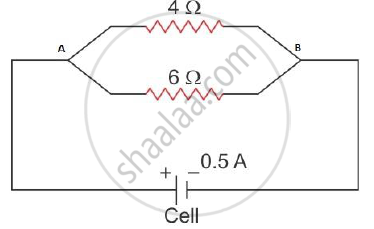
Two resistors of 4Ω and 6 Ω are connected in parallel to a cell to draw 0.5 A current from the cell.
(i) Draw a labelled circuit diagram showing the above arrangement.
(ii) Calculate the current in each resistor. What is an Ohmic resistor?
Advertisements
उत्तर
i.
The parallel combination of two resistors 4 Ω and 6 Ω that draws a current of 0.5 A from the cell is as shown below.
ii.
In parallel combination of resistors potential difference across each resistor is same as the potential difference across the terminals of the battery.
Here current drawn from cell, I = 0.5 A
The effective resistance `1/R=1/R_1+1/R_2`
Here R1=4Ω and R2=6Ω
`therefore 1/R=1/4+1/6`
`therefore 1/R=5/12`
`therefore R=12/5`
`therefore R=2.4 Omega`
APPEARS IN
संबंधित प्रश्न
Find the expression for resistors connected in series.
The substance having infinitely high electrical resistance is called:
(a) conductor
(b) resistor
(c) superconductor
(d) insulator
Name the material which is used for making the heating element of an electric iron.
If five resistances, each of value 0.2 ohm, are connected in series, what will be the resultant resistance?
Name a substance of which the resistance remains almost unchanged by the increase in temperature.
Two bulbs of 100 W and 40 W are connected in series. The current through the 100 W bulb is 1 A. The current through the 40 W bulb will be ______.
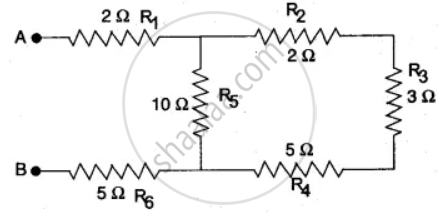
Six resistances are connected together as shown in the figure. Calculate the equivalent resistance between points A and B.
Two resistors having 2Ω and 3Ω resistance are connected—(i) in series, and (ii) in parallel. Find the equivalent resistance in each case.
The resistance of the hot filament of the bulb is about 10 times the cold resistance. What will be the resistance of 100 W-220 V lamps, when not in use?
