Advertisements
Advertisements
प्रश्न
State and explain the laws of resistance.
Advertisements
उत्तर
The following are the main laws of resistance:
(i) Resistance of a conductor is directly proportional to its length, provided temperature and other physical conditions remain unchanged.
It means that R ∝ l i.e., if the length increases, the resistance also increases and if length decreases, its resistance also decreases.
(ii) Resistance of a conductor is inversely proportional to its area of cross section, other conditions remaining the same.
If A is the area of cross section, then:
R α `1/"A"`
or R α `1/(pi"r"^2)`
where r is the radius of the wire
Keeping the length same, if the radius of the wire is doubled then:
R α `1/(2"r")^2` α `1/"4r"^2`
or R α `1/4 . 1/(pi"r"^2)`, or R becomes one fourth.
Similarly if r is made half, then:
R α `1/("r"/2)^2`
α `4/"r"^2 α 4 (1/"r"^2)`, orR becomes 4 times
This shows that R is α `1/"A"`
(iii) R depends on the nature of the material of the conductor. It means, if we take equal lengths of wires of copper, aluminium and iron and all of the same cross-sectional area, their resistance are different from each other since they are of different materials.
संबंधित प्रश्न
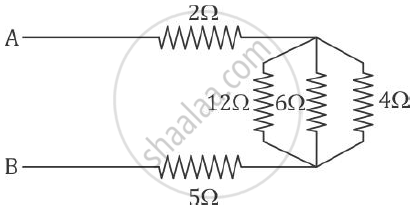
Find the equivalent resistance between points A and B.
Name the material which is the best conductor of electricity.
Write down an expression for the resistance of a metallic wire in terms of the resistivity.
If two resistors of 25 Ω and 15 Ω are joined together in series and then placed in parallel with a 40 Ω resistor, the effective resistance of the combination is :
(a) 0.1 Ω
(b) 10 Ω
(c) 20 Ω
(d)40 Ω
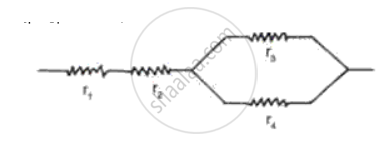
Calculate the equivalent resistance of the following combination of resistor r1, r2, r3, and r4
State a relation between electrical power, resistance and potential difference in an electrical circuit.
What should be the length of a nickel wire of area of cross-section 3 mm2 used for making a rheostat of 750 ohm? (ρ of nickle = 0.069 Ohm mm2/m)
Two electric bulbs have resistances in the ratio 1 : 2. If they are joined in series, the energy consumed in them is in the ratio:
