Advertisements
Advertisements
प्रश्न
What is (a) highest, and (b)Ω lowest, resistance which can be obtained by combining four resistors having the following resistances?
4 Ω, 8 Ω, 12 Ω, 24 Ω
Advertisements
उत्तर
(a) To get the highest resistance, all the resistors must be connected in series.
Resistance in a series arrangement is given by R = R1+ R2 + R3 + R4
R=4Ω+8Ω+12Ω+24Ω
R=48Ω
Therefore, the highest resistance is 48 Ω.
(b) To get the lowest resistance, all the resistors must be connected in parallel.
Resistance in a parallel arrangement is given by:
`1/R=1/R_1+1/R_2+1/R_3+1/R_4`
Here`R_1=4`Ω
`R_2=8` Ω
`R_3=12` Ω
`R_4=24`Ω
`1/R=1/4+1/8+1/12+1/24`
`1/R=(6+3+2+1)/24`
`1/R=12/24`
R=2Ω
Therefore, the lowest resistance of the arrangement is 2 Ω.
APPEARS IN
संबंधित प्रश्न
In series combination which remains constant?
(a) Voltage
(b) Current
(c) Both current and voltage
(d) Both are variables
If the length of a wire is doubled by taking more of wire, what happens to its resistance?
How does the presence of impurities in a metal affect its resistance?
Two resistances X and Y are connected turn by turn:
- in parallel, and
- in series.
In which case the resultant resistance will be less than either of the individual resistances?
A p.d. of 4 V is applied to two resistors of 6 Ω and 2 Ω connected in series. Calculate:
(a) the combined resistance
(b) the current flowing
(c) the p.d. across the 6 Ω resistor
The diagram below shows part of a circuit:
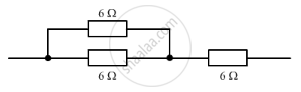
If this arrangement of three resistors was to be replaced by a single resistor, its resistance should be:
(a) 9 Ω
(b) 4 Ω
(c) 6 Ω
(d) 18 Ω
In series combination of resistances ______.
What potential difference is needed to drive a current o f 1 A through a 5 Ω resistor?
How will you oonnect five resistors, each of the value one ohm, to obtain an equivalent resistance of 0.2 `Omega`
Two bulbs of 100 W and 40 W are connected in series. The current through the 100 W bulb is 1 A. The current through the 40 W bulb will be ______.
The voltage applied to a given rheostat is made four times its initial value. By what factor will be resistance of the rheostat change?
Calculate the equivalent resistance between P and Q from the following diagram:
Illustrate-combination of cells e.g., three cells, in series, explaining the combination briefly. Obtain an expression for current ‘i’ in the combination.
Illustrate-combination of cells e.g., three cells, in parallel, explaining the combination briefly. Obtain an expression for current ‘i’ in the combination.
What should be the length of a nickel wire of area of cross-section 3 mm2 used for making a rheostat of 750 ohm? (ρ of nickle = 0.069 Ohm mm2/m)
Calculate the value of the resistance which must be connected to a 15 ohm resistance to provide on effective resistance of 6 ohm.
If the current I through a resistor is increased by 100% (assume that temperature remains unchanged), the increase in power dissipated will be:
Two electric bulbs have resistances in the ratio 1 : 2. If they are joined in series, the energy consumed in them is in the ratio:
