हिंदी

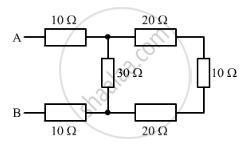
What is the Resistance Between a and B in the Figure Given Below?

Advertisements
Advertisements

प्रश्न
 

Advertisements

उत्तर

The resistors of values 20 Ω, 10 Ω and 20 Ω are connected in series. Therefore, their net resistance is:
R = 20 Ω + 10 Ω + 20 Ω
R = 50 Ω 

This combination of resistors are connected in parallel with that of value 30 Ω. Therefore, the resistance R' is:
1/R' = (1/50) + (1/30)
1/R' = (3 + 5)/150
R' = 150/8
R' = 18.75 Ω

The resistance, R' is connected in series with the two resistors of values 10 Ω each. Hence, the total resistance between A and B is:
18.75 + 10 + 10 = 38.75 Ω

shaalaa.com
  क्या इस प्रश्न या उत्तर में कोई त्रुटि है?
अध्याय 4: Electricity - Exercise 5

APPEARS IN

लखमीर सिंग Physics [English] Class 10
अध्याय 4 Electricity
Exercise 5 | Q 50

संबंधित प्रश्न

In series combination which remains constant?
(a) Voltage
(b) Current
(c) Both current and voltage
(d) Both are variables


Two resistors of 4Ω and 6 Ω are connected in parallel to a cell to draw 0.5 A current from the cell.
(i) Draw a labelled circuit diagram showing the above arrangement.
(ii) Calculate the current in each resistor. What is an Ohmic resistor?


When a 4 Ω resistor is connected across the terminals of a 12 V battery, the number of coulombs passing through the resistor per second is:

(a) 0.3
(b) 3
(c) 4
(d) 12


How does the presence of impurities in a metal affect its resistance?


Write down an expression for the resistance of a metallic wire in terms of the resistivity.


Calculate the resistance of an aluminium cable of length 10 km and diameter 2.0 mm if the resistivity of aluminium is 27 × 10−8 Ωm. 


If two resistors of 25 Ω and 15 Ω are joined together in series and then placed in parallel with a 40 Ω resistor, the effective resistance of the combination is : 

(a) 0.1 Ω
(b) 10 Ω
(c) 20 Ω
(d)40 Ω


State the order of resistivity of (i) a metal, (ii) a semiconductor and (iii) an insulator. 


What are the SI units of specific resistance?

Does an ammeter have a low or high resistance?

What potential difference is needed to drive a current o f 1 A through a 5 Ω resistor?


What is the value of a resistance if 20 V drives 2 A through it?

What is the equivalent resistance between A and B in the given circuit (Fig?)


Answer the following question.
While studying the dependence of potential difference ( V) across a resistor on the current (I) passing through it, in order to determine the resistance of the resistor, a student took 5 readings for different values of current and plotted a graph between V and t. He got a straight line graph passing through the origin. What does the straight-line signify? Write the method of determining the resistance of the resister using this graph. 


A given metallic wire of resistance R is doubled on itself. What will be its new resistance?


Two resistors having 2Ω and 3Ω resistance are connected—(i) in series, and (ii) in parallel. Find the equivalent resistance in each case.


What is the maximum resistance which can be made using five resistors each of `1/5` W?


If the current I through a resistor is increased by 100% (assume that temperature remains unchanged), the increase in power dissipated will be:


Share
Notifications

Englishहिंदीमराठी


      Forgot password?
Use app×