Advertisements
Advertisements
Question
Advertisements
Solution
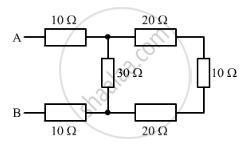
The resistors of values 20 Ω, 10 Ω and 20 Ω are connected in series. Therefore, their net resistance is:
R = 20 Ω + 10 Ω + 20 Ω
R = 50 Ω
This combination of resistors are connected in parallel with that of value 30 Ω. Therefore, the resistance R' is:
1/R' = (1/50) + (1/30)
1/R' = (3 + 5)/150
R' = 150/8
R' = 18.75 Ω
The resistance, R' is connected in series with the two resistors of values 10 Ω each. Hence, the total resistance between A and B is:
18.75 + 10 + 10 = 38.75 Ω
APPEARS IN
RELATED QUESTIONS
Judge the equivalent resistance when the following are connected in parallel − (a) 1 Ω and 106Ω, (b) 1 Ω and 103Ω and 106Ω.
Write any two characteristics of a series combination of resistors.
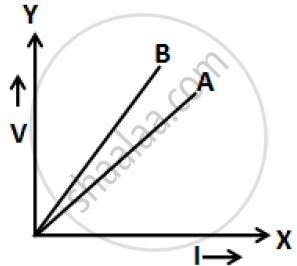
The V-I graph for a series combination and for a parallel combination of two resistors is shown in the figure below. Which of the two A or B. represents the parallel combination? Give reasons for your answer.
(i) Two sets A and B, of three bulbs each, are glowing in two separate rooms. When one of the bulbs in set A is fused, the other two bulbs also cease to glow. But in set B, when one bulb fuses, the other two bulbs continue to glow. Explain why this phenomenon occurs.
(ii) Why do we prefer arrangements of Set B for house circuiting?
If the length of a wire is doubled by taking more of wire, what happens to its resistance?
How does the resistance of a wire change when:
its length is tripled?
If five resistances, each of value 0.2 ohm, are connected in series, what will be the resultant resistance?
V = IRTwo resistances X and Y are connected turn by turn : (i) in parallel, and (ii) series. In which case the resultant resistance will be less than either of the individual resistances?R = R1+ R2+ R3
You are supplied with a number of 100 Ω resistors. How could you combine some of these resistors to make a 250 Ω resistor?
You have three resistors of values 2 `Omega`, 3 `Omega`, and 5 `Omega`. How will you join them so that the total resistance is less than 2 `Omega`?
Choose the correct alternative and rewrite the following sentence.
If three resistors 2 ohms, 3 ohms and 4 ohms are connected in series, then the effective resistance in the circuit will be _______ ohms.
Calculate the equivalent resistance between P and Q from the following diagram:
Calculate the quantity of heat that will be produced in a coil of resistance 75 Ω if a current of 2A is passed through it for 2 minutes.
The resistance of the hot filament of the bulb is about 10 times the cold resistance. What will be the resistance of 100 W-220 V lamps, when not in use?
What is the maximum resistance which can be made using five resistors each of `1/5` W?
In an electrical circuit, two resistors of 2 Ω and 4 Ω respectively are connected in series to a 6 V battery. The heat dissipated by the 4 Ω resistor in 5 s will be ______.
