Advertisements
Advertisements
Question
If five resistances, each of value 0.2 ohm, are connected in series, what will be the resultant resistance?
Advertisements
Solution
If five resistors, each of value 0.2 Ω, are connected in series, the resultant resistance will be the sum of the individual resistances.
R = R1 + R2 + R3 + R4 + R5
R = 0.2 + 0.2 +0.2 + 0.2 + 0.2
R = 5 x 0.2
R = 1 Ω
APPEARS IN
RELATED QUESTIONS
Find the expression for resistors connected in series.
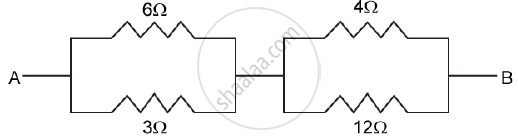
Find the equivalent resistance between A and B
The substance having infinitely high electrical resistance is called:
(a) conductor
(b) resistor
(c) superconductor
(d) insulator
How does the presence of impurities in a metal affect its resistance?
Two resistances X and Y are connected turn by turn:
- in parallel, and
- in series.
In which case the resultant resistance will be less than either of the individual resistances?
Calculate the combined resistance in the given case:

State the order of resistivity of (i) a metal, (ii) a semiconductor and (iii) an insulator.
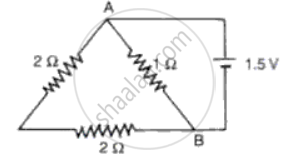
What is the equivalent resistance between A and B in the given circuit (Fig?)
You have three resistors of values 2 `Omega`, 3 `Omega`, and 5 `Omega`. How will you join them so that the total resistance is less than 2 `Omega`?
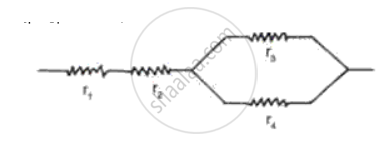
Calculate the equivalent resistance of the following combination of resistor r1, r2, r3, and r4
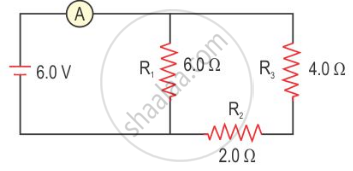
Three resistors of 6.0 Ω, 2.0 Ω and 4.0 Ω are joined to an ammeter A and a cell of emf 6.0 V as shown in the following figure. Calculate :
- the effective resistance of the circuit.
- the reading of ammeter.
What do you mean by power rating of an electrical appliance? How do you use it to calculate
(a) the resistance of the appliance and
(b) the safe limit of the current in it, while in use?
Bends in a rubber pipe reduce the flow of water through it. How would the bands in a wire affect its electric resistance?
Two resistors of 4Ω and 6Ω are connected in parallel to a cell to draw 0.5 A current from the cell.
Draw a labelled circuit diagram showing the above arrangement.
If R1 and R2 be the resistance of the filament of 40 W and 60 W respectively operating 220 V, then:
In an electrical circuit, two resistors of 2 Ω and 4 Ω respectively are connected in series to a 6 V battery. The heat dissipated by the 4 Ω resistor in 5 s will be ______.
When a 4 Ω resistor is connected across the terminals of a 2 V battery, the number of coulombs passing through the resistor per second is:
Show how you would connect three resistors, each of resistance 6 Ω, so that the combination has a resistance of 4 Ω.
