Advertisements
Advertisements
Question
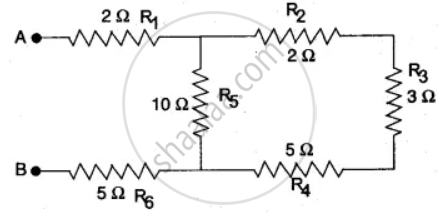
Six resistances are connected together as shown in the figure. Calculate the equivalent resistance between points A and B.
Advertisements
Solution
The resistors R2, R3 and R4 in series.
∴ R' = R2 + R3 + R4
= 2 + 3 + 5 = 10 Ω
Now R' and R5 are in parallel.
∴ `1/("R"'') = 1/("R"') + 1/"R"_5`
`= 1/10 + 1/10 = 2/10 = 1/5`
∴ R'' = 5 Ω
Now R1, R” and R6 in series between the points A and B. The equivalent resistance between A and B is
R = R1 + R” + R6 = 2 + 5 + 5 = 12 Ω
RELATED QUESTIONS
(i) Two sets A and B, of three bulbs each, are glowing in two separate rooms. When one of the bulbs in set A is fused, the other two bulbs also cease to glow. But in set B, when one bulb fuses, the other two bulbs continue to glow. Explain why this phenomenon occurs.
(ii) Why do we prefer arrangements of Set B for house circuiting?
Two resistances X and Y are connected turn by turn:
- in parallel, and
- in series.
In which case the resultant resistance will be less than either of the individual resistances?
Choose the correct alternative and rewrite the following:
You are given three equal resistances. In how many combinations can they are arranged?
How does the resistance of an alloy, vary with temperature?
Bends in a rubber pipe reduce the flow of water through it. How would the bands in a wire affect its electric resistance?
2Ω resistor A, 1Ω resistor B and 4Ω resistor C are connected in parallel. The combination is connected across a 2V battery of negligible resistance. Draw the diagram of the arrangement and calculate:
(i) The current in each resistor A and C,
(ii) The current through battery.
Calculate the value of the resistance which must be connected to a 15 ohm resistance to provide on effective resistance of 6 ohm.
What is the maximum resistance which can be made using five resistors each of `1/5` W?
Two electric bulbs have resistances in the ratio 1 : 2. If they are joined in series, the energy consumed in them is in the ratio:
