Advertisements
Advertisements
Question
Find the expression for resistors connected in series.
Advertisements
Solution
When two or more resistors are joined from end to end, the resistances are connected in series.
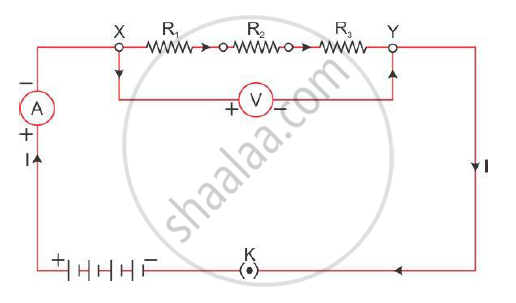
The current in series remains the same across all the resistors.
The potential difference is the sum of potential differences across all the individual resistors.
V = V1 + V2 + V3 … (1)
Let I be the current in the circuit.
On applying Ohm’s law to the entire circuit, we get
V = IRs … (2)
Here, Rs is the combined resistance of the circuit.
Now, applying Ohm’s law to individual resistances, we get
V1 = IR1
V2 = IR2
V3 = IR3 ......(3)
From equations (1), (2) and (3), we get
IRs = IR1 + IR2 + IR3
∴ Rs = R1 + R2 + R3
Here, Rs is the resultant resistance. Thus, the resultant resistance of a series combination of resistors is the sum of individual resistances.
The resultant resistance is greater than all the resistances.
APPEARS IN
RELATED QUESTIONS
Two resistors of 4Ω and 6 Ω are connected in parallel to a cell to draw 0.5 A current from the cell.
(i) Draw a labelled circuit diagram showing the above arrangement.
(ii) Calculate the current in each resistor. What is an Ohmic resistor?
When a 4 Ω resistor is connected across the terminals of a 12 V battery, the number of coulombs passing through the resistor per second is:
(a) 0.3
(b) 3
(c) 4
(d) 12
If two resistors of 25 Ω and 15 Ω are joined together in series and then placed in parallel with a 40 Ω resistor, the effective resistance of the combination is :
(a) 0.1 Ω
(b) 10 Ω
(c) 20 Ω
(d)40 Ω
What is (a) highest, and (b)Ω lowest, resistance which can be obtained by combining four resistors having the following resistances?
4 Ω, 8 Ω, 12 Ω, 24 Ω
Draw a V-I graph for a conductor at two different temperatures. What conclusion do you draw from your graph for the variation of resistance of conductor with temperature?
You have three resistors of values 2 `Omega`, 3 `Omega`, and 5 `Omega`. How will you join them so that the total resistance is less than 2 `Omega`?
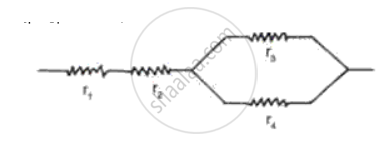
Calculate the equivalent resistance of the following combination of resistor r1, r2, r3, and r4
Choose the correct alternative and rewrite the following sentence.
If three resistors 2 ohms, 3 ohms and 4 ohms are connected in series, then the effective resistance in the circuit will be _______ ohms.
Two bulbs of 100 W and 40 W are connected in series. The current through the 100 W bulb is 1 A. The current through the 40 W bulb will be ______.
A given metallic wire of resistance R is doubled on itself. What will be its new resistance?
Why are thick copper wires used as connecting wires?
How does the resistivity of a semiconductor depend on temperature?
State and explain the laws of resistance.
Four resistances of 2.0Ω each are joined end to end, to form a square ABCD. Calculate the equivalent resistance of the combination between any two adjacent comers.
Illustrate-combination of cells e.g., three cells, in parallel, explaining the combination briefly. Obtain an expression for current ‘i’ in the combination.
Two wires of the same length and area made of two materials of resistivity ρ1 and ρ2 are connected in series to a source of potential V. The equivalent resistivity for the same area is:
If R1 and R2 be the resistance of the filament of 40 W and 60 W respectively operating 220 V, then:
