Advertisements
Advertisements
Question
Two lamps of resistance 30Ω and 20Ω respectively are connected in series in a 110V circuit. Calculate:
(i) the total resistance in the circuit
(ii) the current in the circuit, and
(iii) the voltage drop across each lamp.
Advertisements
Solution
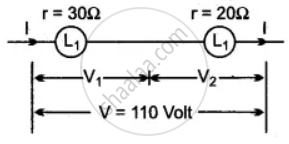
(i) Since the two lamps are connected in series, their total resistance R is given by:
R = R1 + R2
= 30 Ω + 20 Ω = 50 Ω
(ii) We have, V = 110 volt, R = 50 Ω
∴ By Ohm's law
I = `"V"/"R" = 110/50`A = 2.2 A
(iii) We now have
I = 2.2 A
∴ V1 = IR1 = 2.2 × 30V = 66 V
∴ Voltage frop across L1 = 66 V
Similarly, V2 = IR2 = 2.2 × 20 = 44 V
∴ Voltage drop across L2 = 44 V.
RELATED QUESTIONS
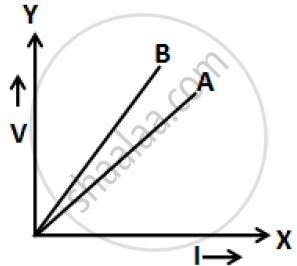
The V-I graph for a series combination and for a parallel combination of two resistors is shown in the figure below. Which of the two A or B. represents the parallel combination? Give reasons for your answer.
Name the material which is the best conductor of electricity.
Calculate the resistance of an aluminium cable of length 10 km and diameter 2.0 mm if the resistivity of aluminium is 27 × 10−8 Ωm.
Give the law of combination of resistances in series.
What possible values of resultant resistance one can get by combining two resistances, one of value 2 ohm and the other 6 ohm?
The diagram below shows part of a circuit:
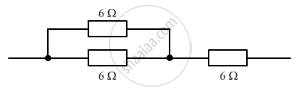
If this arrangement of three resistors was to be replaced by a single resistor, its resistance should be:
(a) 9 Ω
(b) 4 Ω
(c) 6 Ω
(d) 18 Ω
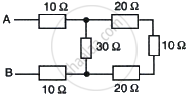
What is the resistance between A and B in the figure given below?
Choose the correct alternative and rewrite the following sentence.
If three resistors 2 ohms, 3 ohms and 4 ohms are connected in series, then the effective resistance in the circuit will be _______ ohms.
Two wires of the same length and area made of two materials of resistivity ρ1 and ρ2 are connected in series to a source of potential V. The equivalent resistivity for the same area is:
Show how you would connect three resistors, each of resistance 6 Ω, so that the combination has a resistance of 4 Ω.
