Advertisements
Advertisements
प्रश्न
Two lamps of resistance 30Ω and 20Ω respectively are connected in series in a 110V circuit. Calculate:
(i) the total resistance in the circuit
(ii) the current in the circuit, and
(iii) the voltage drop across each lamp.
Advertisements
उत्तर
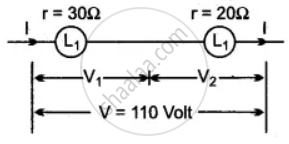
(i) Since the two lamps are connected in series, their total resistance R is given by:
R = R1 + R2
= 30 Ω + 20 Ω = 50 Ω
(ii) We have, V = 110 volt, R = 50 Ω
∴ By Ohm's law
I = `"V"/"R" = 110/50`A = 2.2 A
(iii) We now have
I = 2.2 A
∴ V1 = IR1 = 2.2 × 30V = 66 V
∴ Voltage frop across L1 = 66 V
Similarly, V2 = IR2 = 2.2 × 20 = 44 V
∴ Voltage drop across L2 = 44 V.
संबंधित प्रश्न
The substance having infinitely high electrical resistance is called:
(a) conductor
(b) resistor
(c) superconductor
(d) insulator
Give one example to show how the resistance depends on the nature of material of the conductor.
A p.d. of 4 V is applied to two resistors of 6 Ω and 2 Ω connected in series. Calculate:
(a) the combined resistance
(b) the current flowing
(c) the p.d. across the 6 Ω resistor
The voltage applied to a given rheostat is made four times its initial value. By what factor will be resistance of the rheostat change?
Three resistors of 6Ω, 3Ω and 2Ω are connected together so that their total resistance is greater than 6Ω but less than 8Ω Draw a diagram to show this arrangement and calculate its total resistance.
If R1 and R2 be the resistance of the filament of 40 W and 60 W respectively operating 220 V, then:
The resistance of the hot filament of the bulb is about 10 times the cold resistance. What will be the resistance of 100 W-220 V lamps, when not in use?
Consider the following combinations of resistors:


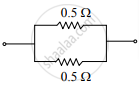
The combinations having equivalent resistance 1 Q is/are ______.
