Advertisements
Advertisements
प्रश्न
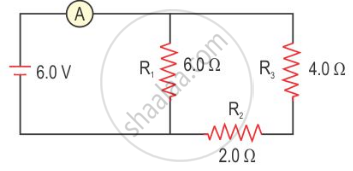
Three resistors of 6.0 Ω, 2.0 Ω and 4.0 Ω are joined to an ammeter A and a cell of emf 6.0 V as shown in the following figure. Calculate :
- the effective resistance of the circuit.
- the reading of ammeter.
Advertisements
उत्तर
From circuit diagram
R3 and R2 are in series
R3 = i.e 4 + 2 = 6 Ω
Now R3 and R1 are in parallel
- Total resistance = `1/"R" = 1/6 + 1/6`
= `2/6` or
R = `6/2 `
= 3 Ω - I = `"V"/"R"`
= `6.0/3.0`
= 2 A
APPEARS IN
संबंधित प्रश्न
What is (a) highest, and (b)Ω lowest, resistance which can be obtained by combining four resistors having the following resistances?
4 Ω, 8 Ω, 12 Ω, 24 Ω
In series combination of resistances ______.
You have three resistors of values 2 `Omega`, 3 `Omega`, and 5 `Omega`. How will you join them so that the total resistance is less than 2 `Omega`?
State and explain the laws of resistance.
Calculate the equivalent resistance between the points A and B for the following combination of resistors:
When a 4 Ω resistor is connected across the terminals of a 2 V battery, the number of coulombs passing through the resistor per second is:
Two electric bulbs have resistances in the ratio 1 : 2. If they are joined in series, the energy consumed in them is in the ratio:
Show how you would connect three resistors, each of resistance 6 Ω, so that the combination has a resistance of 4 Ω.
