Advertisements
Advertisements
प्रश्न
Give the law of combination of resistances in series.
Advertisements
उत्तर
APPEARS IN
संबंधित प्रश्न
In series combination which remains constant?
(a) Voltage
(b) Current
(c) Both current and voltage
(d) Both are variables
Find the expression for the resistors connected in series and write the two characteristics of it. (Draw figure).
If the equivalent resistance is to be increased, then the number of resistances should be connected in
- Series
- Parallel
- Mixed arrangement
- None of the above
A battery of 9 V is connected in series with resistors of 0.2 Ω, 0.3 Ω, 0.4 Ω, 0.5 Ω and 12 Ω, respectively. How much current would flow through the 12 Ω resistor?
Write any two characteristics of a series combination of resistors.
The substance having infinitely high electrical resistance is called:
(a) conductor
(b) resistor
(c) superconductor
(d) insulator
Name the material which is the best conductor of electricity.
The diagram below shows part of a circuit:
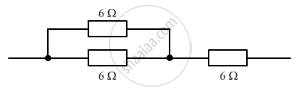
If this arrangement of three resistors was to be replaced by a single resistor, its resistance should be:
(a) 9 Ω
(b) 4 Ω
(c) 6 Ω
(d) 18 Ω
What is the resistance between A and B in the figure given below?
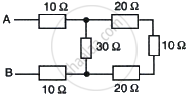
What is the equivalent resistance between A and B in the given circuit (Fig?)
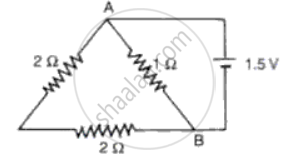
When do you say that the resistors are connected in this way? Draw a circuit diagram.
Calculate the equivalent resistance between P and Q from the following diagram:
Illustrate-combination of cells e.g., three cells, in parallel, explaining the combination briefly. Obtain an expression for current ‘i’ in the combination.
Two resistors of 4Ω and 6Ω are connected in parallel to a cell to draw 0.5 A current from the cell.
Draw a labelled circuit diagram showing the above arrangement.
With the help of a circuit diagram derive the formula for the resultant resistance of three resistances connected:
- in series and
- in parallel
If R1 and R2 be the resistance of the filament of 40 W and 60 W respectively operating 220 V, then:
