Advertisements
Advertisements
Question
Give the law of combination of resistances in series.
Advertisements
Solution
APPEARS IN
RELATED QUESTIONS
In series combination which remains constant?
(a) Voltage
(b) Current
(c) Both current and voltage
(d) Both are variables
If the length of a wire is doubled by taking more of wire, what happens to its resistance?
Calculate the resistance of an aluminium cable of length 10 km and diameter 2.0 mm if the resistivity of aluminium is 27 × 10−8 Ωm.
How does the resistance of a wire change when:
its diameter is tripled?
What possible values of resultant resistance one can get by combining two resistances, one of value 2 ohm and the other 6 ohm?
The diagram below shows part of a circuit:
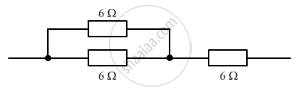
If this arrangement of three resistors was to be replaced by a single resistor, its resistance should be:
(a) 9 Ω
(b) 4 Ω
(c) 6 Ω
(d) 18 Ω
State the order of resistivity of (i) a metal, (ii) a semiconductor and (iii) an insulator.
Choose the correct alternative and rewrite the following sentence.
If three resistors 2 ohms, 3 ohms and 4 ohms are connected in series, then the effective resistance in the circuit will be _______ ohms.
Bends in a rubber pipe reduce the flow of water through it. How would the bands in a wire affect its electric resistance?
How does the resistivity of an alloy such as constantace depends on temperature.
State expression for Resistance connected in series.
State a relation between electrical power, resistance and potential difference in an electrical circuit.
Six resistances are connected together as shown in the figure. Calculate the equivalent resistance between points A and B.
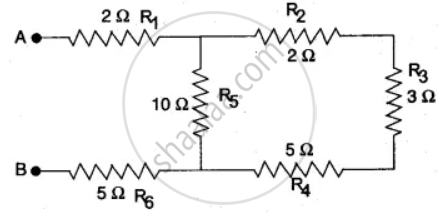
In the circuit shown below, calculate the equivalent resistance between the points (i) A and B, (ii) C and D.
Two lamps of resistance 30Ω and 20Ω respectively are connected in series in a 110V circuit. Calculate:
(i) the total resistance in the circuit
(ii) the current in the circuit, and
(iii) the voltage drop across each lamp.
Two resistors of 4Ω and 6Ω are connected in parallel to a cell to draw 0.5 A current from the cell. Calculate the current in each resistor.
Two wires of the same length and area made of two materials of resistivity ρ1 and ρ2 are connected in series to a source of potential V. The equivalent resistivity for the same area is:
The resistance of the hot filament of the bulb is about 10 times the cold resistance. What will be the resistance of 100 W-220 V lamps, when not in use?
When a 4 Ω resistor is connected across the terminals of a 2 V battery, the number of coulombs passing through the resistor per second is:
