Advertisements
Advertisements
Question
State the order of resistivity of (i) a metal, (ii) a semiconductor and (iii) an insulator.
Advertisements
Solution
Metal < Semiconductor < Insulator
RELATED QUESTIONS
If the equivalent resistance is to be increased, then the number of resistances should be connected in
- Series
- Parallel
- Mixed arrangement
- None of the above
How does the resistance of a wire change when:
its diameter is tripled?
What possible values of resultant resistance one can get by combining two resistances, one of value 2 ohm and the other 6 ohm?
Calculate the combined resistance in each case:
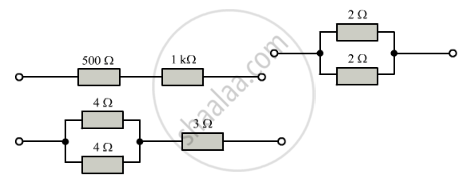
In series combination of resistances ______.
Answer the following question.
While studying the dependence of potential difference ( V) across a resistor on the current (I) passing through it, in order to determine the resistance of the resistor, a student took 5 readings for different values of current and plotted a graph between V and t. He got a straight line graph passing through the origin. What does the straight-line signify? Write the method of determining the resistance of the resister using this graph.
Write an expression for calculating electrical power in terms of current and resistance.
Two wires of same material and same lengths have radii in the ratio of 2 : 3, Compare their resistances.
Two resistors having 2Ω and 3Ω resistance are connected—(i) in series, and (ii) in parallel. Find the equivalent resistance in each case.
In an electrical circuit, two resistors of 2 Ω and 4 Ω respectively are connected in series to a 6 V battery. The heat dissipated by the 4 Ω resistor in 5 s will be ______.
