Advertisements
Advertisements
Question
A p.d. of 4 V is applied to two resistors of 6 Ω and 2 Ω connected in series. Calculate:
(a) the combined resistance
(b) the current flowing
(c) the p.d. across the 6 Ω resistor
Advertisements
Solution
(a) When two resistors are connected in series, their resultant resistance is given by
R = R1+ R2
Here, R1=6Ω ,
R2=2 Ω
Therefore
The resulatant resistance, R = 6 + 2 = 8 Ω
(b) The current flowing through circuit is:
V = IR
I = V/R = 4/8
I = 0.5 A
(c) The p.d. across the 6 Ω resistor is:
V = 0.5 A x 6 Ω = 3 V
APPEARS IN
RELATED QUESTIONS
In series combination which remains constant?
(a) Voltage
(b) Current
(c) Both current and voltage
(d) Both are variables
If the equivalent resistance is to be increased, then the number of resistances should be connected in
- Series
- Parallel
- Mixed arrangement
- None of the above
A battery of 9 V is connected in series with resistors of 0.2 Ω, 0.3 Ω, 0.4 Ω, 0.5 Ω and 12 Ω, respectively. How much current would flow through the 12 Ω resistor?
How does the resistance of a wire change when:
its length is tripled?
Give the law of combination of resistances in series.
What is (a) highest, and (b)Ω lowest, resistance which can be obtained by combining four resistors having the following resistances?
4 Ω, 8 Ω, 12 Ω, 24 Ω
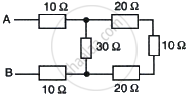
What is the resistance between A and B in the figure given below?
You are supplied with a number of 100 Ω resistors. How could you combine some of these resistors to make a 250 Ω resistor?
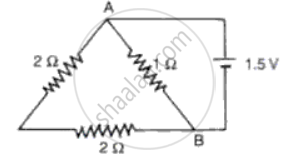
What is the equivalent resistance between A and B in the given circuit (Fig?)
When do you say that the resistors are connected in this way? Draw a circuit diagram.
How does the resistivity of an alloy such as constantace depends on temperature.
State a relation between electrical power, resistance and potential difference in an electrical circuit.
What is the equivalent resistance between the points X and Y for the given network?
Illustrate-combination of cells e.g., three cells, in parallel, explaining the combination briefly. Obtain an expression for current ‘i’ in the combination.
Calculate the value of the resistance which must be connected to a 15 ohm resistance to provide on effective resistance of 6 ohm.
Two resistors having 2Ω and 3Ω resistance are connected—(i) in series, and (ii) in parallel. Find the equivalent resistance in each case.
The resistance of two resistors joined in series is 8Ω and in parallel is 1.5Ω. Find the value of the two resistances.
