Advertisements
Advertisements
प्रश्न
A p.d. of 4 V is applied to two resistors of 6 Ω and 2 Ω connected in series. Calculate:
(a) the combined resistance
(b) the current flowing
(c) the p.d. across the 6 Ω resistor
Advertisements
उत्तर
(a) When two resistors are connected in series, their resultant resistance is given by
R = R1+ R2
Here, R1=6Ω ,
R2=2 Ω
Therefore
The resulatant resistance, R = 6 + 2 = 8 Ω
(b) The current flowing through circuit is:
V = IR
I = V/R = 4/8
I = 0.5 A
(c) The p.d. across the 6 Ω resistor is:
V = 0.5 A x 6 Ω = 3 V
APPEARS IN
संबंधित प्रश्न
If the equivalent resistance is to be increased, then the number of resistances should be connected in
- Series
- Parallel
- Mixed arrangement
- None of the above
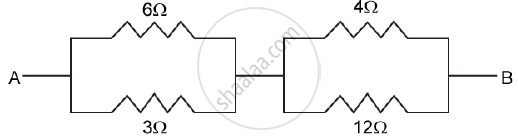
Find the equivalent resistance between A and B
When a 4 Ω resistor is connected across the terminals of a 12 V battery, the number of coulombs passing through the resistor per second is:
(a) 0.3
(b) 3
(c) 4
(d) 12
The substance having infinitely high electrical resistance is called:
(a) conductor
(b) resistor
(c) superconductor
(d) insulator
Calculate the resistance of an aluminium cable of length 10 km and diameter 2.0 mm if the resistivity of aluminium is 27 × 10−8 Ωm.
If five resistances, each of value 0.2 ohm, are connected in series, what will be the resultant resistance?
What possible values of resultant resistance one can get by combining two resistances, one of value 2 ohm and the other 6 ohm?
Name the following substance showing low resistivity.
Name the material of wire used for making standard resistances. Give a reason.
What material is used for making wire to prepare heating coils? Give a reason.
How does the resistivity of an alloy such as constantace depends on temperature.
State and explain the laws of resistance.
You are provided with three resistors of resistance 1.0 Ω, 2.0 Ω and 3.0 Ω How would you connect them to obtain the total effective resistance 1.5 Ω? Draw diagram of the arrangement and check it by calculations.
Two lamps of resistance 30Ω and 20Ω respectively are connected in series in a 110V circuit. Calculate:
(i) the total resistance in the circuit
(ii) the current in the circuit, and
(iii) the voltage drop across each lamp.
Calculate the quantity of heat that will be produced in a coil of resistance 75 Ω if a current of 2A is passed through it for 2 minutes.
Two wires of same material and same lengths have radii in the ratio of 2 : 3, Compare their resistances.
When a 4 Ω resistor is connected across the terminals of a 2 V battery, the number of coulombs passing through the resistor per second is:
