Advertisements
Advertisements
Question
What possible values of resultant resistance one can get by combining two resistances, one of value 2 ohm and the other 6 ohm?
Advertisements
Solution
Connecting a 2 Ω and 6 Ω resistor in series combination:
`R=R_1+R_2`
R= 2Ω+6Ω=8Ω
Thus, we will get an 8 Ω resistor
Connecting a 2 Ω and 6 Ω resistor in parallel combination:
`1/R=1/R_1+1/R_2`
`1/R=1/2+1/6`
⇒`1/R=4/6`
⇒ `R=6/4 `Ω
Thus, we will get a 1.5 Ω resistor.
APPEARS IN
RELATED QUESTIONS
Find the expression for the resistors connected in series and write the two characteristics of it. (Draw figure).
Complete the following :-
(a)

Find the expression for resistors connected in series.
Judge the equivalent resistance when the following are connected in parallel − (a) 1 Ω and 106Ω, (b) 1 Ω and 103Ω and 106Ω.
Write any two characteristics of a series combination of resistors.
(i) Two sets A and B, of three bulbs each, are glowing in two separate rooms. When one of the bulbs in set A is fused, the other two bulbs also cease to glow. But in set B, when one bulb fuses, the other two bulbs continue to glow. Explain why this phenomenon occurs.
(ii) Why do we prefer arrangements of Set B for house circuiting?
Write down an expression for the resistance of a metallic wire in terms of the resistivity.
State how are the two resistors joined with a battery when same current flows in each resistor.
In series combination of resistances ______.
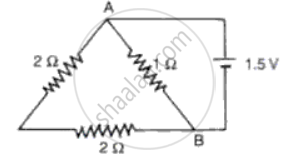
What is the equivalent resistance between A and B in the given circuit (Fig?)
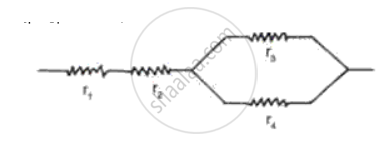
Calculate the equivalent resistance of the following combination of resistor r1, r2, r3, and r4
To increase the effective resistance in a circuit, the resistors are connected in _______________ .
Choose the correct alternative and rewrite the following:
You are given three equal resistances. In how many combinations can they are arranged?
When do you say that the resistors are connected in this way? Draw a circuit diagram.
You are provided with three resistors of resistance 1.0 Ω, 2.0 Ω and 3.0 Ω How would you connect them to obtain the total effective resistance 1.5 Ω? Draw diagram of the arrangement and check it by calculations.
Three resistors of 6Ω, 3Ω and 2Ω are connected together so that their total resistance is greater than 6Ω but less than 8Ω Draw a diagram to show this arrangement and calculate its total resistance.
What is the equivalent resistance between the points X and Y for the given network?
Two lamps of resistance 30Ω and 20Ω respectively are connected in series in a 110V circuit. Calculate:
(i) the total resistance in the circuit
(ii) the current in the circuit, and
(iii) the voltage drop across each lamp.
Consider the following combinations of resistors:


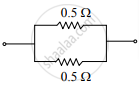
The combinations having equivalent resistance 1 Q is/are ______.
