Advertisements
Advertisements
Question
2Ω resistor A, 1Ω resistor B and 4Ω resistor C are connected in parallel. The combination is connected across a 2V battery of negligible resistance. Draw the diagram of the arrangement and calculate:
(i) The current in each resistor A and C,
(ii) The current through battery.
Advertisements
Solution
The diagram of the arrangement is shown in given figure.
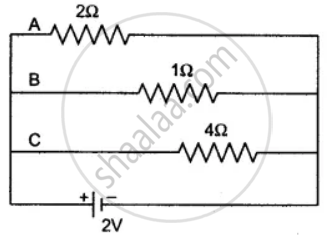
(i) The current in resistor A is I1 = `"V"/"R"_1 = 2/2 = 1.0`A
The current in resistor B is I2 = `"V"/"R"_2 = 2/1 = 2.0`A
The current in resistor B is I3 = `"V"/"R"_3 = 2/4 = 0.5`A
(ii) The current through battery
I = I1 + I2 + I3
I = 1.0 + 2.0 + 0.5
= 3.5 Ampere.
RELATED QUESTIONS
In series combination which remains constant?
(a) Voltage
(b) Current
(c) Both current and voltage
(d) Both are variables
Two resistors of 4Ω and 6 Ω are connected in parallel to a cell to draw 0.5 A current from the cell.
(i) Draw a labelled circuit diagram showing the above arrangement.
(ii) Calculate the current in each resistor. What is an Ohmic resistor?
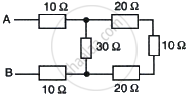
What is the resistance between A and B in the figure given below?
What do you mean by power rating of an electrical appliance? How do you use it to calculate
(a) the resistance of the appliance and
(b) the safe limit of the current in it, while in use?
Choose the correct alternative and rewrite the following sentence.
If three resistors 2 ohms, 3 ohms and 4 ohms are connected in series, then the effective resistance in the circuit will be _______ ohms.
A given metallic wire of resistance R is doubled on itself. What will be its new resistance?
What is a resistance? Define it with respect to Ohm’s law,
Calculate the equivalent resistance between P and Q from the following diagram:
The resistance of the hot filament of the bulb is about 10 times the cold resistance. What will be the resistance of 100 W-220 V lamps, when not in use?
In an electrical circuit, two resistors of 2 Ω and 4 Ω respectively are connected in series to a 6 V battery. The heat dissipated by the 4 Ω resistor in 5 s will be ______.
