Advertisements
Advertisements
Question
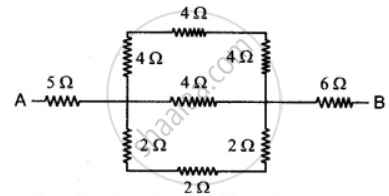
Calculate the equivalent resistance between the points A and B for the following combination of resistors:
Advertisements
Solution
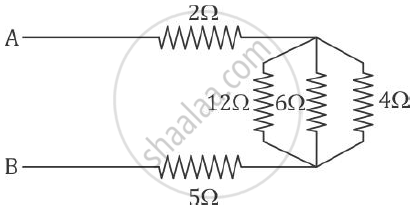
`1/("R"_1') = 1/12 + 1/4 + 1/6 = (1 + 3 + 2)/12 = 6/12`
`1/("R"_1') = 1/2`
R1' = 2 Ω
Total resistance = 5 + 2 + 6 = 13 ohm.
RELATED QUESTIONS
Find the expression for the resistors connected in series and write the two characteristics of it. (Draw figure).
A piece of wire of resistance R is cut into five equal parts. These parts are then connected in parallel. If the equivalent resistance of this combination is R’, then the ratio `"R"/"R'"` is ______.
Find the equivalent resistance between points A and B.
Calculate the resistance of an aluminium cable of length 10 km and diameter 2.0 mm if the resistivity of aluminium is 27 × 10−8 Ωm.
If five resistances, each of value 0.2 ohm, are connected in series, what will be the resultant resistance?
The diagram below shows part of a circuit:
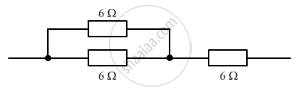
If this arrangement of three resistors was to be replaced by a single resistor, its resistance should be:
(a) 9 Ω
(b) 4 Ω
(c) 6 Ω
(d) 18 Ω
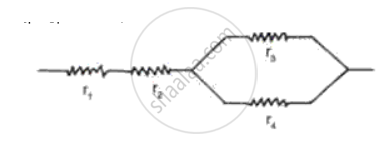
Calculate the equivalent resistance of the following combination of resistor r1, r2, r3, and r4
How does the resistance of an alloy, vary with temperature?
The voltage applied to a given rheostat is made four times its initial value. By what factor will be resistance of the rheostat change?
If the current I through a resistor is increased by 100% (assume that temperature remains unchanged), the increase in power dissipated will be:
