Advertisements
Advertisements
प्रश्न
Calculate the equivalent resistance between the points A and B for the following combination of resistors:
Advertisements
उत्तर
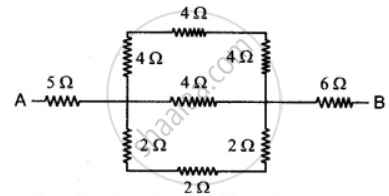
`1/("R"_1') = 1/12 + 1/4 + 1/6 = (1 + 3 + 2)/12 = 6/12`
`1/("R"_1') = 1/2`
R1' = 2 Ω
Total resistance = 5 + 2 + 6 = 13 ohm.
संबंधित प्रश्न
Complete the following :-
(a)

Name the material which is used for making the heating element of an electric iron.
How does the resistance of a pure metal change if its temperature decreases?
How does the presence of impurities in a metal affect its resistance?
If two resistors of 25 Ω and 15 Ω are joined together in series and then placed in parallel with a 40 Ω resistor, the effective resistance of the combination is :
(a) 0.1 Ω
(b) 10 Ω
(c) 20 Ω
(d)40 Ω
You are supplied with a number of 100 Ω resistors. How could you combine some of these resistors to make a 250 Ω resistor?
What material is used for making wire to prepare heating coils? Give a reason.
A metal wire of resistance 6 Ω is stretched so that its length is increased to twice its original length. Calculate its new resistance.
Consider the following combinations of resistors:


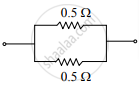
The combinations having equivalent resistance 1 Q is/are ______.
