Advertisements
Advertisements
प्रश्न
What is a resistance? Define it with respect to Ohm’s law,
Advertisements
उत्तर
In the flow of current in a conductor, electrons are drifted. During this drift or flow, electrons mutually collide against each other and the atoms of the conductor. These collisions give rise to some obstruction to the flow of electrons. This opposition or obstruction offered by a conductor to the flow of electrons is called ‘Resistance’. According to Ohm’s law, the ratio between potential difference V and the current i, is a constant provided the temperature and physical conditions of the conductor remain unaltered. As such the ratio V/I is called the resistance, i.e., ‘Ohmic resistance’ of the conductor.
संबंधित प्रश्न
If the equivalent resistance is to be increased, then the number of resistances should be connected in
- Series
- Parallel
- Mixed arrangement
- None of the above
Find the equivalent resistance between points A and B
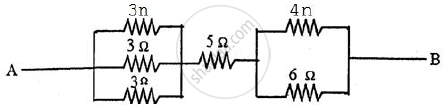
What is the equivalent resistance between A and B in the given circuit (Fig?)
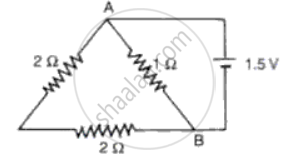
When do you say that the resistors are connected in this way? Draw a circuit diagram.
What should be the length of a nickel wire of area of cross-section 3 mm2 used for making a rheostat of 750 ohm? (ρ of nickle = 0.069 Ohm mm2/m)
Two resistors having 2Ω and 3Ω resistance are connected—(i) in series, and (ii) in parallel. Find the equivalent resistance in each case.
With the help of a circuit diagram derive the formula for the resultant resistance of three resistances connected:
- in series and
- in parallel
Two wires of the same length and area made of two materials of resistivity ρ1 and ρ2 are connected in series to a source of potential V. The equivalent resistivity for the same area is:
Show how you would connect three resistors, each of resistance 6 Ω, so that the combination has a resistance of 4 Ω.
