Advertisements
Advertisements
Question
What is a resistance? Define it with respect to Ohm’s law,
Advertisements
Solution
In the flow of current in a conductor, electrons are drifted. During this drift or flow, electrons mutually collide against each other and the atoms of the conductor. These collisions give rise to some obstruction to the flow of electrons. This opposition or obstruction offered by a conductor to the flow of electrons is called ‘Resistance’. According to Ohm’s law, the ratio between potential difference V and the current i, is a constant provided the temperature and physical conditions of the conductor remain unaltered. As such the ratio V/I is called the resistance, i.e., ‘Ohmic resistance’ of the conductor.
RELATED QUESTIONS
A battery of 9 V is connected in series with resistors of 0.2 Ω, 0.3 Ω, 0.4 Ω, 0.5 Ω and 12 Ω, respectively. How much current would flow through the 12 Ω resistor?
Write any two characteristics of a series combination of resistors.
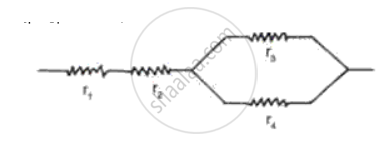
Calculate the equivalent resistance of the following combination of resistor r1, r2, r3, and r4
What material is used for making wire to prepare heating coils? Give a reason.
Write an expression for the resistance of a conducting wire in terms of its length and area of cross-section.
The voltage applied to a given rheostat is made four times its initial value. By what factor will be resistance of the rheostat change?
In the circuit shown below, calculate the equivalent resistance between the points (i) A and B, (ii) C and D.
The resistance of the hot filament of the bulb is about 10 times the cold resistance. What will be the resistance of 100 W-220 V lamps, when not in use?
What is the maximum resistance which can be made using five resistors each of `1/5` W?
When a 4 Ω resistor is connected across the terminals of a 2 V battery, the number of coulombs passing through the resistor per second is:
