Advertisements
Advertisements
प्रश्न
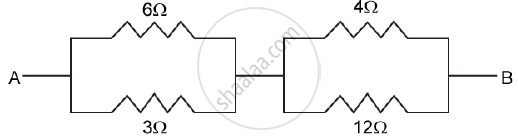
Find the equivalent resistance between A and B
Advertisements
उत्तर
6Ω and 3Ω are in parallel
`:.1/R_p= 1/R_1 + 1/R_2`
`:.R_(P_1) = 6.3/(6+3) = 18/9` = 2 Ω
4Ω and 2Ω are in parallel
`:. 1/R_P = 1/R_1 + 1/R_2`
`:. R_(P_2) = 4.12/(4+12) = 4.12/16 = 3 Ω`
`:. "Total" R_T = R_(P_1) + R_(P_2) = 2 + 3 = 5 Ω`
APPEARS IN
संबंधित प्रश्न
How does the resistance of a pure metal change if its temperature decreases?
How does the resistance of a wire change when:
its length is tripled?
You are supplied with a number of 100 Ω resistors. How could you combine some of these resistors to make a 250 Ω resistor?
State how are the two resistors joined with a battery when same current flows in each resistor.
Write an expression for calculating electrical power in terms of current and resistance.
Four resistances of 2.0Ω each are joined end to end, to form a square ABCD. Calculate the equivalent resistance of the combination between any two adjacent comers.
Calculate the value of the resistance which must be connected to a 15 ohm resistance to provide on effective resistance of 6 ohm.
A metal wire of resistance 6 Ω is stretched so that its length is increased to twice its original length. Calculate its new resistance.
Two wires of same material and same lengths have radii in the ratio of 2 : 3, Compare their resistances.
