Advertisements
Advertisements
प्रश्न
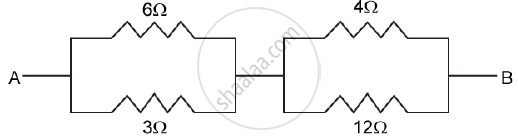
Find the equivalent resistance between A and B
Advertisements
उत्तर
6Ω and 3Ω are in parallel
`:.1/R_p= 1/R_1 + 1/R_2`
`:.R_(P_1) = 6.3/(6+3) = 18/9` = 2 Ω
4Ω and 2Ω are in parallel
`:. 1/R_P = 1/R_1 + 1/R_2`
`:. R_(P_2) = 4.12/(4+12) = 4.12/16 = 3 Ω`
`:. "Total" R_T = R_(P_1) + R_(P_2) = 2 + 3 = 5 Ω`
APPEARS IN
संबंधित प्रश्न
Why is the series arrangement not used for domestic circuits?
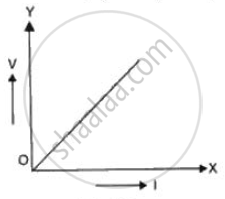
A graph is plotted taking p.d. along y-axis and electric current along x-axis. Name the physical quantity that represents the slope of this graph (Fig.).
Choose the correct alternative and rewrite the following:
You are given three equal resistances. In how many combinations can they are arranged?
What material is used for making wire to prepare heating coils? Give a reason.
State expression for Cells connected in parallel.
What is a resistance? Define it with respect to Ohm’s law,
Two lamps of resistance 30Ω and 20Ω respectively are connected in series in a 110V circuit. Calculate:
(i) the total resistance in the circuit
(ii) the current in the circuit, and
(iii) the voltage drop across each lamp.
Two resistors of 4Ω and 6Ω are connected in parallel to a cell to draw 0.5 A current from the cell.
Draw a labelled circuit diagram showing the above arrangement.
With the help of a circuit diagram derive the formula for the resultant resistance of three resistances connected:
- in series and
- in parallel
The resistance of the hot filament of the bulb is about 10 times the cold resistance. What will be the resistance of 100 W-220 V lamps, when not in use?
