Advertisements
Advertisements
प्रश्न
Calculate the equivalent resistance between P and Q from the following diagram:
Advertisements
उत्तर
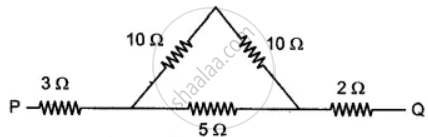
`1/"R"_1 = 1/20 + 1/5`
`1/"R"_1 = (1 + 4)/20 = 5/20`
R1 = 4 Ω
Now, 3 Ω, 4 Ω and 2 Ω in series.
So, R = 3 + 4 + 2 = 9 Ω
संबंधित प्रश्न
Complete the following :-
(a)

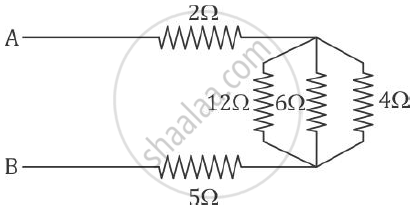
Find the equivalent resistance between points A and B.
How does the presence of impurities in a metal affect its resistance?
State how are the two resistors joined with a battery when equivalent resistance is more than either of the two resistances.
Answer the following question.
While studying the dependence of potential difference ( V) across a resistor on the current (I) passing through it, in order to determine the resistance of the resistor, a student took 5 readings for different values of current and plotted a graph between V and t. He got a straight line graph passing through the origin. What does the straight-line signify? Write the method of determining the resistance of the resister using this graph.
Two bulbs of 100 W and 40 W are connected in series. The current through the 100 W bulb is 1 A. The current through the 40 W bulb will be ______.
How does the resistance of an alloy, vary with temperature?
Two resistors of 4Ω and 6Ω are connected in parallel to a cell to draw 0.5 A current from the cell. Calculate the current in each resistor.
The resistance of two resistors joined in series is 8Ω and in parallel is 1.5Ω. Find the value of the two resistances.
With the help of a circuit diagram derive the formula for the resultant resistance of three resistances connected:
- in series and
- in parallel
