Advertisements
Advertisements
प्रश्न
Two resistors having 2Ω and 3Ω resistance are connected—(i) in series, and (ii) in parallel. Find the equivalent resistance in each case.
Advertisements
उत्तर
Given: R1 = 2 Ω, R2 = 3 Ω
(i) In series : Equivalent resistance R = R1 + R2
or R = 2 + 3 = 5 Ω
(ii) In parallel : Equivalent resistance R = `("R"_1"R"_2)/("R"_1 + "R"_2)`
or R = `(2 xx 3)/(2 + 3) = 6/5 = 1.2 Omega`
संबंधित प्रश्न
Find the expression for resistors connected in series.
If the length of a wire is doubled by taking more of wire, what happens to its resistance?
Draw a V-I graph for a conductor at two different temperatures. What conclusion do you draw from your graph for the variation of resistance of conductor with temperature?
How will you oonnect five resistors, each of the value one ohm, to obtain an equivalent resistance of 0.2 `Omega`
Answer the following question.
While studying the dependence of potential difference ( V) across a resistor on the current (I) passing through it, in order to determine the resistance of the resistor, a student took 5 readings for different values of current and plotted a graph between V and t. He got a straight line graph passing through the origin. What does the straight-line signify? Write the method of determining the resistance of the resister using this graph.
The voltage applied to a given rheostat is made four times its initial value. By what factor will be resistance of the rheostat change?
State expression for Resistance connected in series.
Six resistances are connected together as shown in the figure. Calculate the equivalent resistance between points A and B.
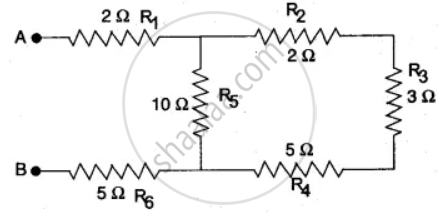
A metal wire of resistance 6 Ω is stretched so that its length is increased to twice its original length. Calculate its new resistance.
If the current I through a resistor is increased by 100% (assume that temperature remains unchanged), the increase in power dissipated will be:
