Advertisements
Advertisements
प्रश्न
The resistance of two resistors joined in series is 8Ω and in parallel is 1.5Ω. Find the value of the two resistances.
Advertisements
उत्तर
In series, R1 + R2 = 8 Ω
In parallel `("R"_1"R"_2)/("R"_1 + "R"_2) = 1.5` Ω
∴ R1R2 = 8 × 1.5 = 12 Ω
Now (R1 - R2)2 = (R1 + R2)2 - 4R1R2
∴ (R1 - R2)2 = (8)2 - 4 × 12
or (R1 - R2)2 = 64 - 48 = 16
or R1 - R2 = 4 Ω
On solving equations (i) and (ii) R1 = 6 Ω and R2 = 2 Ω
संबंधित प्रश्न
In series combination which remains constant?
(a) Voltage
(b) Current
(c) Both current and voltage
(d) Both are variables
Complete the following :-
(a)

Judge the equivalent resistance when the following are connected in parallel − (a) 1 Ω and 106Ω, (b) 1 Ω and 103Ω and 106Ω.
Give the law of combination of resistances in series.
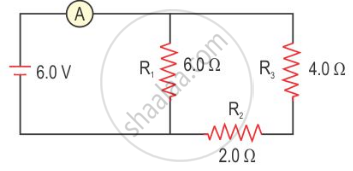
Three resistors of 6.0 Ω, 2.0 Ω and 4.0 Ω are joined to an ammeter A and a cell of emf 6.0 V as shown in the following figure. Calculate :
- the effective resistance of the circuit.
- the reading of ammeter.
What material is used for making wire to prepare heating coils? Give a reason.
The voltage applied to a given rheostat is made four times its initial value. By what factor will be resistance of the rheostat change?
Calculate the value of the resistance which must be connected to a 15 ohm resistance to provide on effective resistance of 6 ohm.
A metal wire of resistance 6 Ω is stretched so that its length is increased to twice its original length. Calculate its new resistance.
