Advertisements
Advertisements
प्रश्न
Illustrate-combination of cells e.g., three cells, in parallel, explaining the combination briefly. Obtain an expression for current ‘i’ in the combination.
Advertisements
उत्तर
Combination of cells in parallel: Let there be n cells, each of e.m.f. E and internal resistance r, be connected in parallel as shown in the diagram.
Total e.m.f. across the point A and B is E

Total internal resistance
`1/"r"_1 = 1/"r" + 1/"r" + 1/"r".... = "n"/"r"` (if there are n cells)
or r1 = `"r"/"n"`
But total resistance of circuit = R + `"r"/"n" = ("nR" + "r")/"n"`
∴ Current i = `"Total e.m.f"/"Total resistance"`
`= "E"/("R" + "r"/"n")`
`= "nE"/("nR + "r"")`
It is advantageous to join cells in parallel when the internal resistance of each cell is quite high as compared to the external resistance R.
Then, Approximately, i = `"nE"/"r"` (neglecting R).
संबंधित प्रश्न
Find the expression for the resistors connected in series and write the two characteristics of it. (Draw figure).
Find the expression for resistors connected in series.
Give one example to show how the resistance depends on the nature of material of the conductor.
If two resistors of 25 Ω and 15 Ω are joined together in series and then placed in parallel with a 40 Ω resistor, the effective resistance of the combination is :
(a) 0.1 Ω
(b) 10 Ω
(c) 20 Ω
(d)40 Ω
State the order of resistivity of (i) a metal, (ii) a semiconductor and (iii) an insulator.
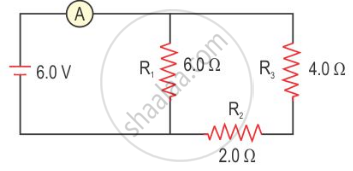
Three resistors of 6.0 Ω, 2.0 Ω and 4.0 Ω are joined to an ammeter A and a cell of emf 6.0 V as shown in the following figure. Calculate :
- the effective resistance of the circuit.
- the reading of ammeter.
What do you mean by power rating of an electrical appliance? How do you use it to calculate
(a) the resistance of the appliance and
(b) the safe limit of the current in it, while in use?
Bends in a rubber pipe reduce the flow of water through it. How would the bands in a wire affect its electric resistance?
What material is used for making wire to prepare heating coils? Give a reason.
