Advertisements
Advertisements
Question
Illustrate-combination of cells e.g., three cells, in parallel, explaining the combination briefly. Obtain an expression for current ‘i’ in the combination.
Advertisements
Solution
Combination of cells in parallel: Let there be n cells, each of e.m.f. E and internal resistance r, be connected in parallel as shown in the diagram.
Total e.m.f. across the point A and B is E

Total internal resistance
`1/"r"_1 = 1/"r" + 1/"r" + 1/"r".... = "n"/"r"` (if there are n cells)
or r1 = `"r"/"n"`
But total resistance of circuit = R + `"r"/"n" = ("nR" + "r")/"n"`
∴ Current i = `"Total e.m.f"/"Total resistance"`
`= "E"/("R" + "r"/"n")`
`= "nE"/("nR + "r"")`
It is advantageous to join cells in parallel when the internal resistance of each cell is quite high as compared to the external resistance R.
Then, Approximately, i = `"nE"/"r"` (neglecting R).
RELATED QUESTIONS
Why is the series arrangement not used for domestic circuits?
Calculate the combined resistance in the given case:

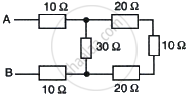
What is the resistance between A and B in the figure given below?
How will you oonnect five resistors, each of the value one ohm, to obtain an equivalent resistance of 0.2 `Omega`
A given metallic wire of resistance R is doubled on itself. What will be its new resistance?
Calculate the quantity of heat that will be produced in a coil of resistance 75 Ω if a current of 2A is passed through it for 2 minutes.
Two wires of same material and same lengths have radii in the ratio of 2 : 3, Compare their resistances.
When a 4 Ω resistor is connected across the terminals of a 2 V battery, the number of coulombs passing through the resistor per second is:
