Advertisements
Advertisements
Question
Write an expression for the resistance of a conducting wire in terms of its length and area of cross-section.
Advertisements
Solution
Let R be the resistance of a conducting wire of length l and area of cross-section A. We then have:
R = ρl/A
Here ρ is a constant characteristic of the material of the wire and is called its resistivity. Thus,
Resistance = `(("Resistivity of the material of the wire") xx ("length of thge wire"))/("Area of cross-section of the wire")`
RELATED QUESTIONS
In series combination which remains constant?
(a) Voltage
(b) Current
(c) Both current and voltage
(d) Both are variables
Find the expression for resistors connected in series.
How does the presence of impurities in a metal affect its resistance?
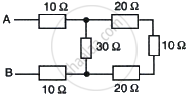
What is the resistance between A and B in the figure given below?
How does the resistance of an alloy, vary with temperature?
What material is used for making wire to prepare heating coils? Give a reason.
Why are thick copper wires used as connecting wires?
How does the resistivity of an alloy such as constantace depends on temperature.
Two lamps of resistance 30Ω and 20Ω respectively are connected in series in a 110V circuit. Calculate:
(i) the total resistance in the circuit
(ii) the current in the circuit, and
(iii) the voltage drop across each lamp.
The resistance of two resistors joined in series is 8Ω and in parallel is 1.5Ω. Find the value of the two resistances.
