Advertisements
Advertisements
Question
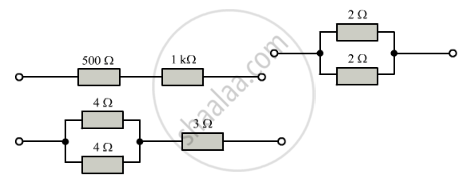
Calculate the combined resistance in each case:
Advertisements
Solution
case 1
Let the total resistance of the combination shown in the diagram below be R.
Here 500 Ω and 1000 Ω resistors are connected in series combination. Their net resistance is given by R = R1+ R2
Here:
R1=500 Ω
R2=1000 Ω
So:
R = 500 + 1000 = 1500 Ω
Thus, the total resistance of the combination is 1500 Ω.
case 2
In the circuit diagram shown above, two 2 Ω resistors are connected in parallel combination.
Therefore:
`1/R_-p=1/R_1+1/R_2`
`1/R_p=1/2+1/2`
`Ω1/R_p=2/2=1`Ω
Thus the total resistance of the combination is 1 Ω.
case 3
In the circuit diagram shown above, two 4 Ω resistors are connected in parallel combination.
Therefore their resulant resistance given by
`1/R=1/R1+1/R_2`
`Here R_1=4`Ω
`R_2=4`Ω
So
`1/R=1/4+1/4`
`or 1/R=2/4`
or R=2Ω
In the above circuit diagram, this 2 Ω and 3 Ω resistors are connected in series combination. So, the total resistance of the circuit can be calculated as:
`R=R_1+R_2`
Here
`R_1=2`â
`R_2=3`â
So:
R=2â+3â=5â
Thus, the total resistance of the combination is 5 â„
APPEARS IN
RELATED QUESTIONS
If the equivalent resistance is to be increased, then the number of resistances should be connected in
- Series
- Parallel
- Mixed arrangement
- None of the above
The V-I graph for a series combination and for a parallel combination of two resistors is shown in the figure below. Which of the two A or B. represents the parallel combination? Give reasons for your answer.

(i) Two sets A and B, of three bulbs each, are glowing in two separate rooms. When one of the bulbs in set A is fused, the other two bulbs also cease to glow. But in set B, when one bulb fuses, the other two bulbs continue to glow. Explain why this phenomenon occurs.
(ii) Why do we prefer arrangements of Set B for house circuiting?
Give the law of combination of resistances in series.
If five resistances, each of value 0.2 ohm, are connected in series, what will be the resultant resistance?
V = IRTwo resistances X and Y are connected turn by turn : (i) in parallel, and (ii) series. In which case the resultant resistance will be less than either of the individual resistances?R = R1+ R2+ R3
What is the equivalent resistance between A and B in the given circuit (Fig?)

A given metallic wire of resistance R is doubled on itself. What will be its new resistance?
How does the resistivity of an alloy such as constantace depends on temperature.
What is a resistance? Define it with respect to Ohm’s law,
Calculate the equivalent resistance between P and Q from the following diagram:
Six resistances are connected together as shown in the figure. Calculate the equivalent resistance between points A and B.

Illustrate-combination of cells e.g., three cells, in series, explaining the combination briefly. Obtain an expression for current ‘i’ in the combination.
If R1 and R2 be the resistance of the filament of 40 W and 60 W respectively operating 220 V, then:
If the current I through a resistor is increased by 100% (assume that temperature remains unchanged), the increase in power dissipated will be:
