Advertisements
Advertisements
Question
What is (a) highest, and (b)Ω lowest, resistance which can be obtained by combining four resistors having the following resistances?
4 Ω, 8 Ω, 12 Ω, 24 Ω
Advertisements
Solution
(a) To get the highest resistance, all the resistors must be connected in series.
Resistance in a series arrangement is given by R = R1+ R2 + R3 + R4
R=4Ω+8Ω+12Ω+24Ω
R=48Ω
Therefore, the highest resistance is 48 Ω.
(b) To get the lowest resistance, all the resistors must be connected in parallel.
Resistance in a parallel arrangement is given by:
`1/R=1/R_1+1/R_2+1/R_3+1/R_4`
Here`R_1=4`Ω
`R_2=8` Ω
`R_3=12` Ω
`R_4=24`Ω
`1/R=1/4+1/8+1/12+1/24`
`1/R=(6+3+2+1)/24`
`1/R=12/24`
R=2Ω
Therefore, the lowest resistance of the arrangement is 2 Ω.
APPEARS IN
RELATED QUESTIONS
A piece of wire of resistance R is cut into five equal parts. These parts are then connected in parallel. If the equivalent resistance of this combination is R’, then the ratio `"R"/"R'"` is ______.
(i) Two sets A and B, of three bulbs each, are glowing in two separate rooms. When one of the bulbs in set A is fused, the other two bulbs also cease to glow. But in set B, when one bulb fuses, the other two bulbs continue to glow. Explain why this phenomenon occurs.
(ii) Why do we prefer arrangements of Set B for house circuiting?
How does the resistance of a wire change when:
its diameter is tripled?
Give the law of combination of resistances in series.
If five resistances, each of value 0.2 ohm, are connected in series, what will be the resultant resistance?
What possible values of resultant resistance one can get by combining two resistances, one of value 2 ohm and the other 6 ohm?
The diagram below shows part of a circuit:
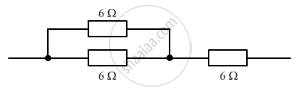
If this arrangement of three resistors was to be replaced by a single resistor, its resistance should be:
(a) 9 Ω
(b) 4 Ω
(c) 6 Ω
(d) 18 Ω
State the order of resistivity of (i) a metal, (ii) a semiconductor and (iii) an insulator.
In series combination of resistances ______.
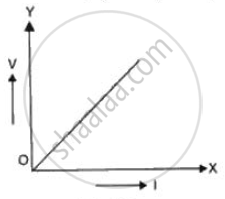
A graph is plotted taking p.d. along y-axis and electric current along x-axis. Name the physical quantity that represents the slope of this graph (Fig.).
Name the following substance showing low resistivity.
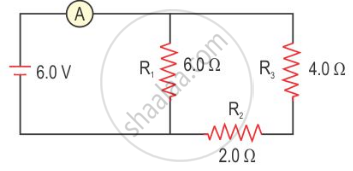
Three resistors of 6.0 Ω, 2.0 Ω and 4.0 Ω are joined to an ammeter A and a cell of emf 6.0 V as shown in the following figure. Calculate :
- the effective resistance of the circuit.
- the reading of ammeter.
When do you say that the resistors are connected in this way? Draw a circuit diagram.
What material is used for making wire to prepare heating coils? Give a reason.
State the effect of rise in temperature on the resistance of semi-conductors.
Six equal resistors of 1 ohm each are connected to form the sides of a hexagon ABCDEF. Calculate the resistance offered by the combination if the current enters at A and leaves it at D.
The resistance of the hot filament of the bulb is about 10 times the cold resistance. What will be the resistance of 100 W-220 V lamps, when not in use?
