Advertisements
Advertisements
प्रश्न
Write an expression for the resistance of a conducting wire in terms of its length and area of cross-section.
Advertisements
उत्तर
Let R be the resistance of a conducting wire of length l and area of cross-section A. We then have:
R = ρl/A
Here ρ is a constant characteristic of the material of the wire and is called its resistivity. Thus,
Resistance = `(("Resistivity of the material of the wire") xx ("length of thge wire"))/("Area of cross-section of the wire")`
संबंधित प्रश्न
Why is the series arrangement not used for domestic circuits?
Find the equivalent resistance between points A and B
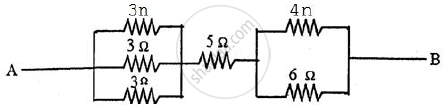
Calculate the combined resistance in the given case:

Name a substance of which the resistance remains almost unchanged by the increase in temperature.
Answer the following question.
While studying the dependence of potential difference ( V) across a resistor on the current (I) passing through it, in order to determine the resistance of the resistor, a student took 5 readings for different values of current and plotted a graph between V and t. He got a straight line graph passing through the origin. What does the straight-line signify? Write the method of determining the resistance of the resister using this graph.
2Ω resistor A, 1Ω resistor B and 4Ω resistor C are connected in parallel. The combination is connected across a 2V battery of negligible resistance. Draw the diagram of the arrangement and calculate:
(i) The current in each resistor A and C,
(ii) The current through battery.
A metal wire of resistance 6 Ω is stretched so that its length is increased to twice its original length. Calculate its new resistance.
If R1 and R2 be the resistance of the filament of 40 W and 60 W respectively operating 220 V, then:
If the current I through a resistor is increased by 100% (assume that temperature remains unchanged), the increase in power dissipated will be:
