Advertisements
Advertisements
प्रश्न
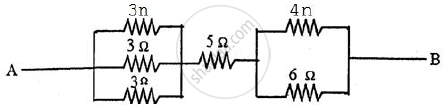
Find the equivalent resistance between points A and B
Advertisements
उत्तर
As shown in the circuit diagram all the 3Ω resistors re connected in parallel.
`1/R_1=1/3+1/3+1/3`
`R_1=1Omega`
Resistors 4Ω and 6Ω are connected in parallel.
`1/R_2=1/4+1/6=5/12`
`R_2=12/5Omega`
Now R1, R2 and 5Ω are connected in series
`R_(AB)=1+12/5+5`
`R_(AB)=42/5`
`R_(AB)=8.4Omega`
संबंधित प्रश्न
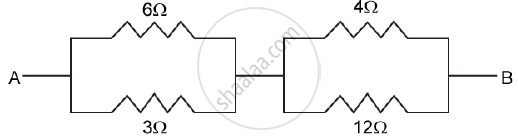
Find the equivalent resistance between A and B
How does the presence of impurities in a metal affect its resistance?
Write down an expression for the resistance of a metallic wire in terms of the resistivity.
What do you mean by power rating of an electrical appliance? How do you use it to calculate
(a) the resistance of the appliance and
(b) the safe limit of the current in it, while in use?
To increase the effective resistance in a circuit, the resistors are connected in _______________ .
Name the material of wire used for making standard resistances. Give a reason.
You are provided with three resistors of resistance 1.0 Ω, 2.0 Ω and 3.0 Ω How would you connect them to obtain the total effective resistance 1.5 Ω? Draw diagram of the arrangement and check it by calculations.
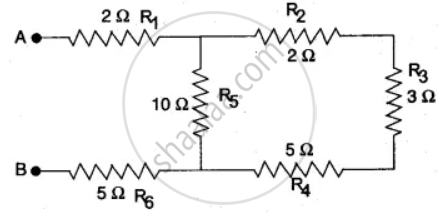
Six resistances are connected together as shown in the figure. Calculate the equivalent resistance between points A and B.
What should be the length of a nickel wire of area of cross-section 3 mm2 used for making a rheostat of 750 ohm? (ρ of nickle = 0.069 Ohm mm2/m)
Two resistors having 2Ω and 3Ω resistance are connected—(i) in series, and (ii) in parallel. Find the equivalent resistance in each case.
