Advertisements
Advertisements
प्रश्न
An electrical appliance is rated at 1000 KVA, 220V. If the appliance is operated for 2 hours, calculate the energy consumed by the appliance in: (i) kWh (ii) joule.
Advertisements
उत्तर
Given: V = 220 volt, 1000 KVA
Time = 2 hours
(i) In kWh Energy consumed = Pt = 2000 kWh
(ii) In joule
We know, 1kWh = 3.6 × 10⁶ J
So, 2000 kWh = `(2000 xx 3.6 xx 10^6)/1`
= 7.2 × 10⁹ Joule
= 7.2 × 10⁹ J
संबंधित प्रश्न
A Radio Set Draws a Current of 0.36 a for 15 Minutes. Calculate the Amount of Electric Charge that Flows Through the Circuit.
A wire of uniform thickness with a resistance of 27Ω is cut into three equal pieces and they are joined in parallel. Find the equivalent resistance of the parallel combination.
What is international convention of colour coding in a cable?
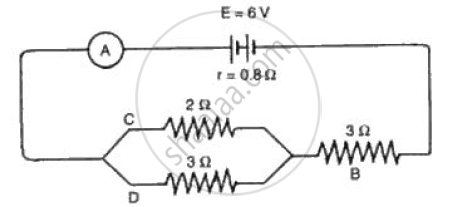
The circuit diagram (Fig.) shows a battery of e.m.f. 6 volts and internal
resistance of 0.8 Ω oonnected in series. Find the
(a) Current reoorded by the ammeter,
(b) P.d. across the terminals of the resistor B,
( c) Current passing through each of the resistors B, C and D, and
( d) P.d. across the terminals of the battery.
What is the function of a step-up transformer?
State whether the current is a scalar or vector?
State the S.I. units of electrical power.
At the time of short circuit, the electric current in the circuit ______.
The SI unit of electric current is:
