Advertisements
Advertisements
प्रश्न
In the circuit diagram given below five resistances of 10 Ω, 40 Ω, 30 Ω, 20 Ω, and 60 Ω are connected as shown to a 12 V battery.
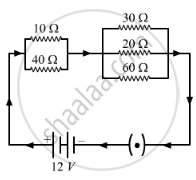
Calculate:
(a) total resistance in the circuit.
(b) total current flowing in the circuit.
Advertisements
उत्तर
(a) When three resistors are connected in parallel, the net resistance can be obtained as followed:
1/R = 1/R1 + 1/R2 + 1/R3
The resistors of 30 Ω, 20 Ω and 60 Ω are connected in parallel. Therefore, the net resistance R will be:
1/R = 1/30 + 1/20 +1/60
1/R = (2 + 3 + 1)/60
1/R = 6/60
R =10 Ω
Two more resistors of 10 Ω and 40 Ω are connected in parallel to each other. Therefore, their net resistance, R' will be:
1/R' = (1/10) + (1/40)
1/R' = (4 + 1)/40
1/R' = 5/40
R' = 8 Ω
The resistors of 8 Ω and 10 Ω are connected in series. Therefore, the net resistance of the circuit =R+R,=8 Ω + 10 Ω = 18 Ω
(b) The total current flowing through the circuit can be calculated as:
I = V/R
I = 12/18
I = 0.67 A
APPEARS IN
संबंधित प्रश्न
Draw the electrical symbols of the following components and state its use
Wire crossing
By what name is the physical quantity coulomb/second called?
In which direction does conventional current flow around a circuit?
What is the unit of electric current?
In 10 s, charge of 25 C leaves a battery, and 200 J of energy are delivered to an outside circuit a result.
What current flows from the battery?
If the amount of electric charge passing through a conductor in 10 minutes is 300 C, the current flowing is:
(a) 30 A
(b) 0.3 A
(c) 0.5 A
(d) 5 A
The p.d. across a 3 Ω resistor is 6 V. The current flowing in the resistor will be:
(a) `1/2A`
(b) 1 A
(c) 2 A
(d) 6 A
A p.d. of 6 V is applied to two resistors of 3 Ω and 6 Ω connected in parallel. Calculate:
(a) the combined resistance
(b) the current flowing in the main circuit
(c) the current flowing in the 3 Ω resistor.
Which is the better way to connect lights and other electrical appliances in domestic wiring: series circuits or parallel circuits? why?
Draw a circuit diagram showing two lamps, one cell and a switch connected in series.
How can you change the brightness of the lamp?
A switch must be connected in:
(a) Live wire (b) neutral wire
(c) earth wire (d) either earth or neutral wire
What would be the danger involved in replacing a blown fuse with the one which would carry a large current?
An electric bulb is rated '100 W, 250 V'. How much current will the bulb draw if connected to a 250 V supply?
Which part of an electrical appliance is earthed?
- What is meant by electric current?
- Name and define its unit.
- Which instrument is used to measure the electric current? How should it be connected in a circuit?
Conventionally, the direction of the current is taken as:
When an electric current is passed, electrons move from:
What does the direction of current convey?
