Advertisements
Advertisements
प्रश्न
Which instrument is used to measure electric current? How should it be connected in a circuit?
Name the device used for measuring electric current. How is it connected in a circuit?
Advertisements
उत्तर
Current is measured by an instrument called an ammeter. An ammeter is always connected in series with the circuit components because it has very low resistance. Connecting it in series ensures that the same current flows through the ammeter as through the circuit, without significantly altering the circuit’s total resistance.
संबंधित प्रश्न
Which of the following equation shows the correct relationship between electrical unit?
1A = 1C/s or 1c= 1A/s
Fill in the folloing blank with suitable words:
A current is a flow of ............... .For this to happen there must be a ............... circuit.
An electric bulb of resistance 20 Ω and a resistance wire of 4 Ω are connected in series with a 6 V battery.
Draw the circuit diagram, and calculate:
(a) total resistance of the circuit.
(b) current through the circuit.
(c) potential difference across the electric bulb.
(d) potential difference across the resistance wire.
Consider the circuit given below:
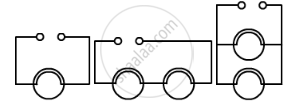
(a) In which circuit are the lamps dimmest?
(b) In which circuit or circuits are the lamps of equal brightness to the lamps in circuit (i)?
(c) Which circuit gives out the maximum light?
How do you think the brightness of two lamps arranged in parallel compares with the brightness of two lamps arranged in series (both arrangements having one cell)?
State two differences between the e.m.f. and terminal voltage of a cell.
Calculate the effective resistance between the points A and B in the network shown below in Figure 8.45
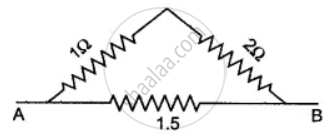
The work done in moving unit positive charge across two points in an electric circuit is a measure of
A bulb marked 12 V, 24 W operates on a 12 volt car battery for 20 minutes. Calculate:
(i) The current flowing through it, and
(ii) The energy liberated.
Define the following:
Electromotive force
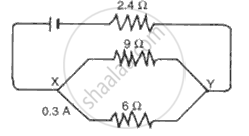
A current of 0.3 A is flowing through a branch of 6 Ω resistors in a junction as shown in fig. . Calculate the
(a) P.d. across the junction XY,
(b) Current flowing through 9Ω and 24Ω
( c) P.d. across 24 Ω resistor, and
( d) e.m.f. of the cell.
An auto lamp is joined to a battery of e.m.f. 4 V and internal resistance 2.5Ω. A steady current of 0.5 A flows through the circuit. Calculate the
(a) Total energy provided by battery in 10 minutes,
(b) Heat dissipated in the bulb in 10 minutes.
Tick (✓) the correct choice among the following :
There are 500 turns and 2000 turns in the primary and secondary coil of a
transformer respectively. If th e output voltage is 1000 V, how large is the
input voltage?
Complete the following:
1 kWh = _________ J
State the condition when it is advantageous to connect cells in parallel.
What determines the direction of flow of electrons between two charged conductors kept in contact?
An electrical appliance is rated at 1000 KVA, 220V. If the appliance is operated for 2 hours, calculate the energy consumed by the appliance in: (i) kWh (ii) joule.
What is the speed of electric current?
Problems for practice:
If 5A current flows through a circuit, then convert the current in terms of microampere?
