Advertisements
Advertisements
प्रश्न
What is the conventional direction of the flow of electric current? How does it differ from the direction of flow electrons?
Advertisements
उत्तर
The conventional direction of the flow of electric current is from the positive terminal of a cell or a battery to its negative terminal through the outer circuit, whereas the direction of flow of electrons is from the negative terminal to the positive terminal of a cell.
APPEARS IN
संबंधित प्रश्न
Write down the formula which relates electric charge, time and electric current
In 10 s, charge of 25 C leaves a battery, and 200 J of energy are delivered to an outside circuit a result.
What current flows from the battery?
A battery of 9 V is connected in series with resistors of 0.2 Ω, 0.3 Ω, 0.4 Ω, 0.5 Ω and 12 Ω. How much current would flow through the 12 Ω resistor?
An electric bulb of resistance 20 Ω and a resistance wire of 4 Ω are connected in series with a 6 V battery.
Draw the circuit diagram, and calculate:
(a) total resistance of the circuit.
(b) current through the circuit.
(c) potential difference across the electric bulb.
(d) potential difference across the resistance wire.
Draw a circuit diagram to show how two 4 V electric lamps can be lit brightly from two 2 V cells.
Give three reasons why different electrical appliances in a domestic circuit are connected in parallel.
For a heater rated at 4 kW and 220 V, calculate:
(a) the current,
(b) the resistance of the heater,
(c) the energy consumed in 2 hours, and
(d) the cost if 1 kWh is priced at Rs 4.60.
A wire of uniform thickness with a resistance of 27Ω is cut into three equal pieces and they are joined in parallel. Find the equivalent resistance of the parallel combination.
Distinguish between an open and a closed circuit.
A charge of 80 C flows in a conductor for 2 minutes.
(a) Calculate the current flowing through the conductor.
(b) If the current through a heater is 4 A what charge must be passing in 8 seconds?
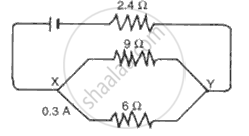
A current of 0.3 A is flowing through a branch of 6 Ω resistors in a junction as shown in fig. . Calculate the
(a) P.d. across the junction XY,
(b) Current flowing through 9Ω and 24Ω
( c) P.d. across 24 Ω resistor, and
( d) e.m.f. of the cell.
An electric bulb is rated at 220 V, 100 W.
- What is its resistance?
- What safe current can be passed through it?
An electric bulb is marked 100 W, 250 V. How much current will the bulb draw if connected to a 250 V supply?
Kilowatt hour is the unit of
The power of an electric device is a product of ______ and ______.
Find the odd one out.
Loudspeaker, Bar magnet/magnet, Electric motor, Microphone.
The relationship between conventional current and electron flow is that they are:
