Advertisements
Advertisements
प्रश्न
What is the conventional direction of the flow of electric current? How does it differ from the direction of flow electrons?
Advertisements
उत्तर
The conventional direction of the flow of electric current is from the positive terminal of a cell or a battery to its negative terminal through the outer circuit, whereas the direction of flow of electrons is from the negative terminal to the positive terminal of a cell.
APPEARS IN
संबंधित प्रश्न
The work done in moving a unit charge across two points in an electric circuit is a measure of ______.
Which of the following equation shows the correct relationship between electrical unit?
1A = 1C/s or 1c= 1A/s
Fill in the folloing blank with suitable words:
A current is a flow of ............... .For this to happen there must be a ............... circuit.
Write down the formula which relates electric charge, time and electric current
An electric bulb of resistance 20 Ω and a resistance wire of 4 Ω are connected in series with a 6 V battery.
Draw the circuit diagram, and calculate:
(a) total resistance of the circuit.
(b) current through the circuit.
(c) potential difference across the electric bulb.
(d) potential difference across the resistance wire.
The circuit diagram given below shows the combination of three resistors R1, R2 and R3:
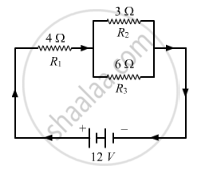
Find :
(i) total resistance of the circuit.
(ii) total current flowing in the circuit.
(iii) the potential difference across R1.
V1, V2 and V3 are the p.ds. across the 1Ω, 2Ω and 3Ω resistors in the following diagram, and the current is 5 A.
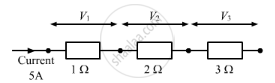
Which one of the columns (a) to (d) shows the correct values of V1, V2 and V3measured in volts?
`V_1` `V_2` `V_3`
(a) 1.0 2.0 3.0
(b) 5.0 10.0 15.0
(c) 5.0 2.5 1.6
(d) 4.0 4.0 2.0
If you were going to connect two light bulbs to one battery, would you use a series or a parallel arrangement? Why? Which arrangement takes more current from the battery?
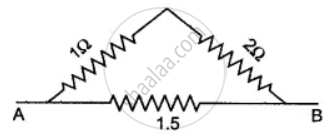
Calculate the effective resistance between the points A and B in the network shown below in Figure 8.45
What is the purpose of a fuse in an electrical circuit?
Tick (✓) the correct choice among the following :
There are 500 turns and 2000 turns in the primary and secondary coil of a
transformer respectively. If th e output voltage is 1000 V, how large is the
input voltage?
Complete the following:
1 kWh = _________ J
State whether the following statement is True or False:
The SI unit of charge is the coulomb.
Answer the following question.
An electric lamp of resistance 20 Ω and a conductor of resistance 4 0 are connected to a 6 V battery as shown in the circuit. Calculate: 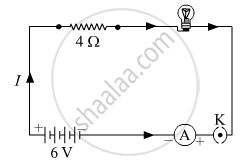
(a) the total resistance of the circuit,
(b) the current through the circuit,
(c) the potential difference across the (i) electric lamp and (ii) conductor, and
(d) power of the lamp.
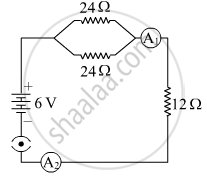
Study the following circuit and find out:
(i) Current in 12 Ω resistor.
(ii) The difference in the readings of A1 and A2, if any.
______ is used to measure the electric current.
One unit of electrical energy consumed is equal to 1000 kilowatt-hour.
A charge of 400C flows through a conductor for 13 minutes and 20 seconds. Find the magnitude of the current flowing through the conductor.
Common sources of Direct Current (DC) are:
