Advertisements
Advertisements
प्रश्न
Which instrument is used to measure electric current? How should it be connected in a circuit?
Name the device used for measuring electric current. How is it connected in a circuit?
Advertisements
उत्तर
Current is measured by an instrument called an ammeter. An ammeter is always connected in series with the circuit components because it has very low resistance. Connecting it in series ensures that the same current flows through the ammeter as through the circuit, without significantly altering the circuit’s total resistance.
संबंधित प्रश्न
Which particles constitute the electric current in a metallic conductor?
What is the unit of electric current?
Ten bulbs are connected in a series circuit to a power supply line. Ten identical bulbs are connected in a parallel circuit to an identical power supply line.
(c) In which circuit, if one bulb blows out, all other will stop glowing?
Which is the better way to connect lights and other electrical appliances in domestic wiring: series circuits or parallel circuits? why?
State three factors on which the heat produced by an electric current depends. How does it depend on these factors?
State two differences between the e.m.f. and terminal voltage of a cell.
The circuit diagram in fig shows two coils of an insulated copper wire wound on a cardboard tube. G is a center zero galvanometer.
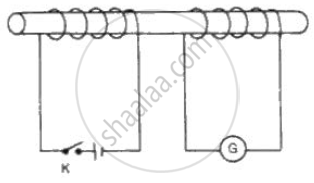
(a) Describe what will happen when th e swi tch K is cl osed for severa l
seconds and then opened again .
(b) What will be the effect of repeating the experiment with an iron placed in the tube?
______ is used to measure the electric current.
MCB is used to protect household electrical appliances.
Which of the following correctly represents the formula for electric current?
In metallic conductors, the charge carriers responsible for producing electric current are:
In electrolytes, the ions carrying charge move toward:
In ionised gases (plasma), the charge carriers are:
Common sources of Direct Current (DC) are:
The value used for practical measurement of Alternating Current is the:
