Advertisements
Advertisements
Questions
Which instrument is used to measure electric current? How should it be connected in a circuit?
Name the device used for measuring electric current. How is it connected in a circuit?
Advertisements
Solution
Current is measured by an instrument called an ammeter. An ammeter is always connected in series with the circuit components because it has very low resistance. Connecting it in series ensures that the same current flows through the ammeter as through the circuit, without significantly altering the circuit’s total resistance.
RELATED QUESTIONS
Draw the electrical symbols of the following components and state its use:
Rheostat (variable resistance)
If the amount of electric charge passing through a conductor in 10 minutes is 300 C, the current flowing is:
(a) 30 A
(b) 0.3 A
(c) 0.5 A
(d) 5 A
The figure given below shows an electric circuit in which current flows from a 6 V battery through two resistors.
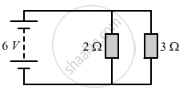
- Are the resistors connected in series with each other or in parallel?
- For each resistors, state the p.d. across it.
- The current flowing from the battery is shared between the two resistors. Which resistor will have bigger share of the current?
- Calculate the effective resistance of the two resistors.
- Calculate the current that flows from the battery.
How does the heat H produced by a current passing through a fixed resistance wire depend on magnitude of current I?
A wire of length 5 m has a resistance of 2.0 Ω calculate:
(a) the resistance of wire of length 1 m
(b) the equivalent resistance if two such wires each of length 2 m are joined in parallel.
(c) the resistance of 1 m length of wire of same material but of half diameter.
A 3 pin mains plug is fitted to the lead for a 1 kW electric kettle to be used on a 250 V A.C. supply. Which of the following statements is NOT correct?
(a) A 13 A fuse is the most appropriate value to use.
(b) The brown wire should be connected to the live side of the mains.
What should I choose ___________________
b. for getting protection from electric current.
c. to measure the current in the circuit?
My mother was operating washing machine on Sunday morning. Suddenly, she saw a spark coming out of the electric board and the electric current in the house failed. An electrician was called to look into the matter. What should he have noticed.
______ is used to measure the electric current.
Name any two devices, which are working on the heating effect of the electric current.
Problems for practice:
If 5A current flows through a circuit, then convert the current in terms of microampere?
A current of 2A passing through the conductor produces 80 J of heat in 10 seconds. The resistance of the conductor is ______.
Calculate the current in a wire if a charge of 1500 coulomb flows through it in 5 minutes.
Match the items in column-I to the items in column-II:
| Column - I | Column - II |
| (i) electric current | (a) volt |
| (ii) potential difference | (b) ohm meter |
| (iii) specific resistance | (c) watt |
| (iv) Electrical power | (d) joule |
| (v) electrical energy | (e) ampere |
In semiconductors, the charge carriers are:
The direction of Direct Current (DC) is characterized as:
