Advertisements
Advertisements
प्रश्न
A flash of lighting carries 10 C of charge which flows for 0.01 s. What is the current? If the voltage is 10 MV, what is the energy?
Advertisements
उत्तर
Given:
Charge, Q = 10 C
Time, t = 0.01 s
Then the current, I = Q / t
So I = 10/0.01 = 1000 A
Also given that:
V = 10 mV = 1,00,00,000 V
So energy = Work done, W = V x Q
= 1,00,00,000 x 10 = 1,00,000,000 J = 100 MJ
APPEARS IN
संबंधित प्रश्न
The SI unit of charge is volt.
What is the unit of electric current?
If 20 C of charge pass a point in a circuit in 1 s, what current is flowing?
A car headlight bulb working on a 12 V car battery draws a current of 0.5 A. The resistance of the light bulb is:
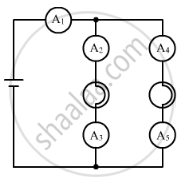
If the lamps are both the same in the figure given below and if A1 reads 0.50 A, what do A2, A3, A4 and A5 read?
Which type of circuit, series or parallel, is preferred while connecting a large number of bulbs:
(a) for decorating a hotel building from outside?
Tick(✓) the correct choice in the following:
When the length of a conductor is doubled the resistance of the conductor
will
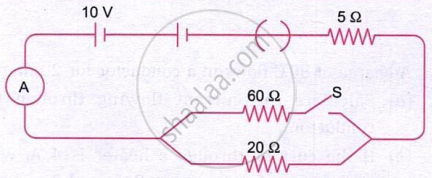
In the circuit shown in fig., find the reading of the ammeter A when the switch S is opened.
A bulb marked 12 V, 24 W operates on a 12 V battery for 20 minutes. Calculate:
- The current flowing through it, and
- The energy consumed.
A bulb is connected to a battery of p.d. 4 V and internal resistance 2.5 Ω . A steady current of 0.5 A flows through the circuit. Calculate:
The total energy supplied by the battery in 10 minutes
Two electric bulbs rated 100 W; 220 V and 60 W; 220 V are connected in parallel to electric mains of 220 V. Find the current drawn by the bulbs from the mains.
______ is used to measure the electric current.
Which of the following represents voltage?
What are the effects of electric current?
A current of 2A passing through the conductor produces 80 J of heat in 10 seconds. The resistance of the conductor is ______.
By convention, the direction of electric current in the external circuit is taken as:
