Advertisements
Advertisements
प्रश्न
Advertisements
उत्तर
When no current is drawn from the cell i.e. when the cell is in open circuit, the potential difference between the terminals of the cell is called its electromotive force (or e.m.f).
APPEARS IN
संबंधित प्रश्न
Which of the following equation shows the correct relationship between electrical unit?
1A = 1C/s or 1c= 1A/s
Why should the resistance of:
a voltmeter be very large?
A battery of 9 V is connected in series with resistors of 0.2 Ω, 0.3 Ω, 0.4 Ω, 0.5 Ω and 0.12 Ω. How much current would flow through the 12 Ω resistor?
A wire of uniform thickness with a resistance of 27Ω is cut into three equal pieces and they are joined in parallel. Find the equivalent resistance of the parallel combination.
Complete the following table. The first answer has been given as an example
| Quantity | Unit |
|
(a) Electrical potential Volt ( b) Resistance ( c) Power ( d) Energy ( e) Resistivity |
Volt ........ .......... ............ .............. |
The circuit diagram in fig shows two coils of an insulated copper wire wound on a cardboard tube. G is a center zero galvanometer.
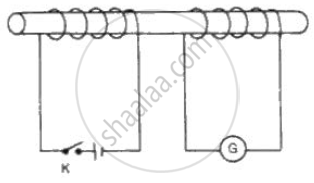
(a) Describe what will happen when th e swi tch K is cl osed for severa l
seconds and then opened again .
(b) What will be the effect of repeating the experiment with an iron placed in the tube?
Tick (✓) the correct choice among the following :
(a) A strong short bar magnet is dropped into a solenoid connected to a
galvanometer as shown in fig . The galvanometer shows a deflection to the left when the current in the coil as seen from above is counter clockwise. Which one of the following shows the correct deflection of the galvanometer when the magnet is at posi tions A, Band C.
A bulb marked 12 V, 24 W operates on a 12 V battery for 20 minutes. Calculate:
- The current flowing through it, and
- The energy consumed.
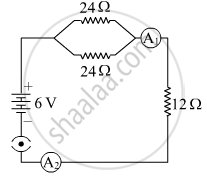
Study the following circuit and find out:
(i) Current in 12 Ω resistor.
(ii) The difference in the readings of A1 and A2, if any.