Advertisements
Advertisements
प्रश्न
Advertisements
उत्तर
When no current is drawn from the cell i.e. when the cell is in open circuit, the potential difference between the terminals of the cell is called its electromotive force (or e.m.f).
APPEARS IN
संबंधित प्रश्न
If the current through a floodlamp is 5 A, what charge passed in 10 seconds?
(a) 0.5 C
(b) 2 C
(c) 5 C
(d) 50 C
A car headlight bulb working on a 12 V car battery draws a current of 0.5 A. The resistance of the light bulb is:
(a) 0.5 Ω
(b) 6 Ω
(c) 12 Ω
(d) 24 Ω
A battery and three lamps are connected as shown:
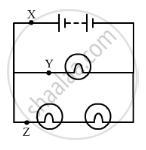
Which of the following statements about the currents at X, Y and Z is correct?
(a) The current at Z is greater than that at Y.
(b) The current at Y is greater than that at Z.
(c) The current at X equals the current at Y.
(d) The current at X equals the current at Z.
The lamps in a house hold circuit are connected in parallel because:
(a) this way they required less current
(b) if one lamp fails the others remain lit
(c) this way they require less power
(d) if one lamp fails the other also fail
Find the potential difference required to pass a current of 0.2 A in a wire of resistance 20Ω
Tell the odd one out. Give a proper explanation.
The work done in moving unit positive charge across two points in an electric circuit is a measure of
An electric iron is rated 750 W, 230 V. Calculate the electrical energy consumed by the press in 16 hours.
State expression for Cells connected in series.
What are the effects of electric current?
