Advertisements
Advertisements
Question
A flash of lighting carries 10 C of charge which flows for 0.01 s. What is the current? If the voltage is 10 MV, what is the energy?
Advertisements
Solution
Given:
Charge, Q = 10 C
Time, t = 0.01 s
Then the current, I = Q / t
So I = 10/0.01 = 1000 A
Also given that:
V = 10 mV = 1,00,00,000 V
So energy = Work done, W = V x Q
= 1,00,00,000 x 10 = 1,00,000,000 J = 100 MJ
APPEARS IN
RELATED QUESTIONS
Three 2 V cells are connected in series and used as a battery in a circuit.
How many joules of electrical energy does 1 C gain on passing through (i) one cell (ii) all three cells?
One coulomb of charge flows through any cross-section of a conductor in 1 second. What is the current flowing through the conductor?
Which statement/statement is/are correct?
1. An ammeter is connected in series in a circuit and a voltmeter is connected in parallel.
2. An ammeter has a high resistance.
3. A voltmeter has a low resistance.
(a) 1, 2, 3
(b) 1, 2
(c) 2, 3
(d) 1
How many electrons are flowing per second past a point in a circuit in which there is a current of 5 amp?
In which of the following cases more electrical energy is consumed per hour?
(i) A current of 1 ampere passed through a resistance of 300 ohms.
(ii) A current of 2 amperes passed through a resistance of 100 ohms.
Two resistors of 2.0 Ω and 3.0 Ω are connected (a) in series (b) in parallel, with a battery of 6.0 V and negligible internal resistance. For each case draw a circuit diagram and calculate the current through the battery.
Tell the odd one out. Give a proper explanation.
Find the effective resistance in the following circuit diagrams (Fig.):
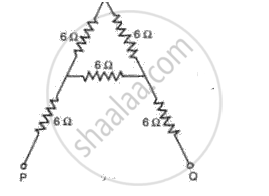
Find the effective resistance in the following circuit diagrams (Fig.):
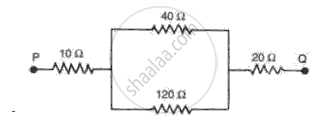
Complete the following table. The first answer has been given as an example.
| Quantity | Unit | |
| (a) | Electrical potential | volt |
| (b) | Resistance | ........ |
| (c) | Power | ........ |
| (d) | Energy | ........ |
| (e) | Resistivity | ........ |
A wire is passed through a piece of cardboard as shown in fig .. An electric current flows vertically down the wire and then flows back up. The two sections of the write are observed to repel each other.
(a) Wi th the aid of a diagram, describe how you would plot the magnetic field lines on the card .
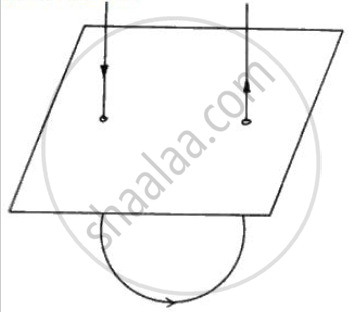
(b) Sketch the magnetic field patterns around both the sections of the wire. Use your sketch to explain why the two sections repel each other.
(c) The repulsive force between the two sections is small. What changes could be made to increase it?
Answer the following question.
An electric lamp of resistance 20 Ω and a conductor of resistance 4 0 are connected to a 6 V battery as shown in the circuit. Calculate: 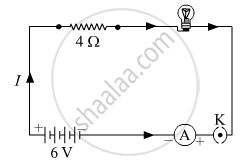
(a) the total resistance of the circuit,
(b) the current through the circuit,
(c) the potential difference across the (i) electric lamp and (ii) conductor, and
(d) power of the lamp.
Two electric bulbs rated 100 W; 220 V and 60 W; 220 V are connected in parallel to electric mains of 220 V. Find the current drawn by the bulbs from the mains.
What determines the direction of flow of electrons between two charged conductors kept in contact?
What is the speed of electric current?
Find the odd one out.
Loudspeaker, Bar magnet/magnet, Electric motor, Microphone.
What does the direction of current convey?
