Advertisements
Advertisements
Question
A wire is passed through a piece of cardboard as shown in fig .. An electric current flows vertically down the wire and then flows back up. The two sections of the write are observed to repel each other.
(a) Wi th the aid of a diagram, describe how you would plot the magnetic field lines on the card .
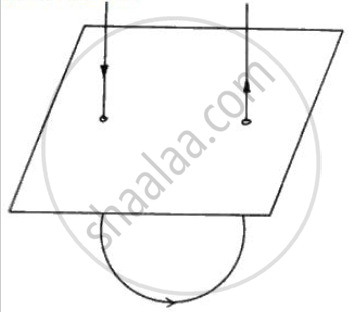
(b) Sketch the magnetic field patterns around both the sections of the wire. Use your sketch to explain why the two sections repel each other.
(c) The repulsive force between the two sections is small. What changes could be made to increase it?
Advertisements
Solution
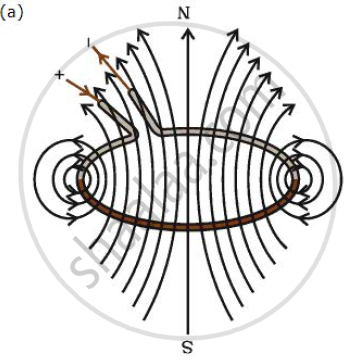
(b) Since the magnetic field lines pass through the loop in th e same direction, the two sections repel each other.
(c) To increase the repulsive force, the current through the loop should be increased .
APPEARS IN
RELATED QUESTIONS
Three 2 V cells are connected in series and used as a battery in a circuit.
- What is the p.d. at the terminals of the battery?
- How many joules of electrical energy does 1 C gain on passing through
- one cell
- all three cells?
A 5 V battery is connected to two 20 Ω resistors which are joined together in series.
(a) Draw a circuit diagram to represent this. Add an arrow to indicate the direction of conventional current flow in the circuit.
(b) What is the effective resistance of the two resistors?
(c) Calculate the current that flows from the battery?
(d) What is the p.d. across each resistor?
A charge of 80 C flows in a conductor for 2 minutes.
(a) Calculate the current flowing through the conductor.
(b) If the current through a heater is 4 A what charge must be passing in 8 seconds?
Fig. shows a 3 pin plug with the cover removed. The electric cable
connected to the plug contains 3 wires with colour coded insulation namely brown, blue and green.
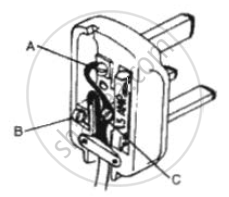
- Identify each of the colour coded wires by stating to which of the
terminals A, B or C in the diagram they should be connected. - Identify the terminal through which no current passes in normal
circumstances. - What is the purpose of the earthed wire connected to an electric
appliance like an electric heater? Describe how it works.
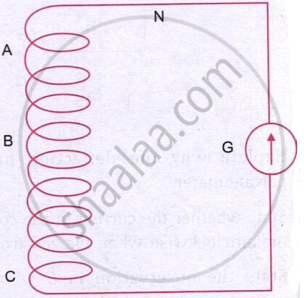
A strong short bar magnet is dropped into a solenoid connected to a
galvanometer as shown in fig. The galvanometer shows a deflection to the left when the current in the coil as seen from above is counter clockwise. Which one of the following shows the correct deflection of the galvanometer when the magnet is at posi tions A, Band C.
At the time of short circuit, the electric current in the circuit ______.
What is the speed of electric current?
What is the rate at which charges flow past a point on a circuit?
In semiconductors, the charge carriers are:
