Advertisements
Advertisements
प्रश्न
A wire is passed through a piece of cardboard as shown in fig .. An electric current flows vertically down the wire and then flows back up. The two sections of the write are observed to repel each other.
(a) Wi th the aid of a diagram, describe how you would plot the magnetic field lines on the card .
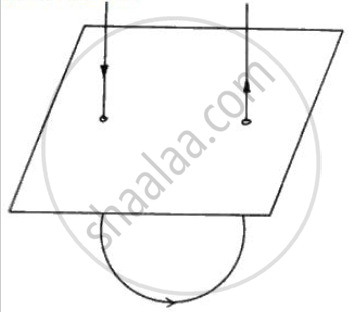
(b) Sketch the magnetic field patterns around both the sections of the wire. Use your sketch to explain why the two sections repel each other.
(c) The repulsive force between the two sections is small. What changes could be made to increase it?
Advertisements
उत्तर
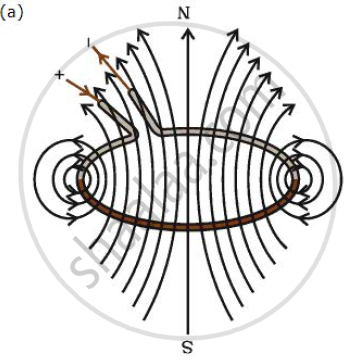
(b) Since the magnetic field lines pass through the loop in th e same direction, the two sections repel each other.
(c) To increase the repulsive force, the current through the loop should be increased .
APPEARS IN
संबंधित प्रश्न
Define the unit of current.
The figure given below shows an electric circuit in which current flows from a 6 V battery through two resistors.
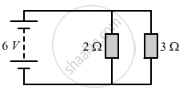
- Are the resistors connected in series with each other or in parallel?
- For each resistors, state the p.d. across it.
- The current flowing from the battery is shared between the two resistors. Which resistor will have bigger share of the current?
- Calculate the effective resistance of the two resistors.
- Calculate the current that flows from the battery.
If the current passing through a conductor is doubled, what will be the change in heat produced
State three factors on which the heat produced by an electric current depends. How does it depend on these factors?
State the S.I. unit of current.
Tell the odd one out. Give a proper explanation.
A fuse is a short piece of wire of high ______ and low ______.
An auto lamp is joined to a battery of e.m.f. 4 V and internal resistance 2.5Ω. A steady current of 0.5 A flows through the circuit. Calculate the
(a) Total energy provided by battery in 10 minutes,
(b) Heat dissipated in the bulb in 10 minutes.
At the time of short circuit, the electric current in the circuit ______.
An electrical gadget can give an electric shock to its user under certain circumstances. Mention any two of these circumstances.
