Advertisements
Advertisements
प्रश्न
Define the unit of current.
Define the S.I. unit of electric current.
Advertisements
उत्तर
The unit of electric current is ampere (A). When one coulomb charge flows through an electric circuit in one second, then the electric current flowing through the circuit is said to be an ampere.
संबंधित प्रश्न
1 A = _________ mA
- 102
- 103
- 10-3
- 10-6
Why are metals good conductors of electricity whereas glass is a bad conductor of electricity? Give reason?
How many milliamperes as there in 1 ampere?
<p> Define the unit of electric current (or Define ampere).
Which statement/statement is/are correct?
1. An ammeter is connected in series in a circuit and a voltmeter is connected in parallel.
2. An ammeter has a high resistance.
3. A voltmeter has a low resistance.
(a) 1, 2, 3
(b) 1, 2
(c) 2, 3
(d) 1
Using the circuit given below, state which of the following statement is correct?
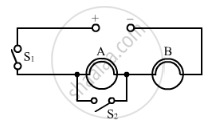
(a) When S1 and S2 are closed, lamps A and B are lit.22
(b) With S1 open and S2 closed, A is lit and B is not lit.
(c) With S2 open and S1 closed A and B are lit.
(d) With S1 closed and S2 open, lamp A remains lit even if lamp B gets fused.
Draw a circuit diagram showing two lamps, one cell and a switch connected in series.
How can you change the brightness of the lamp?
An electric bulb is rated as 10 W, 220 V. How many of these bulbs can be connected in parallel across the two wires of 220 V supply line if the maximum current which can be drawn is 5 A?
Distinguish between an open and a closed circuit.
Define the following:
Electromotive force
If a fuse contains a 5 A fuse wire and the voltage is 240 V, what is the maximum power (wattage) which may be taken from the circuit?
Fig. shows a 3 pin plug with the cover removed. The electric cable
connected to the plug contains 3 wires with colour coded insulation namely brown, blue and green.
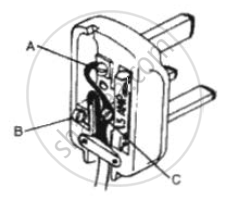
- Identify each of the colour coded wires by stating to which of the
terminals A, B or C in the diagram they should be connected. - Identify the terminal through which no current passes in normal
circumstances. - What is the purpose of the earthed wire connected to an electric
appliance like an electric heater? Describe how it works.
Explain with the help of a diagram how does 'short circuiting' occur in an electric kettle.
Electrical power P is given by the expression P = (Q × V) ÷ time
(a) What do the symbols Q and V represent?
(b) Express the power P in terms of current and resistance explaining the meanings of symbols used there in.
Define the term kilowatt - hour and state its value in S.I. unit.
An electric bulb is marked '100 W, 250 V'. What information does this convey?
A bulb is connected to a battery of p.d. 4 V and internal resistance 2.5 Ω . A steady current of 0.5 A flows through the circuit. Calculate:
The total energy supplied by the battery in 10 minutes
An electrical gadget can give an electric shock to its user under certain circumstances. Mention any two of these circumstances.
When an electric current is passed, electrons move from:
In metallic conductors, the charge carriers responsible for producing electric current are:
In electrolytes, the ions carrying charge move toward:
