Advertisements
Advertisements
प्रश्न
A bulb of 40 W is used for 12.5 h each day for 30 days. Calculate the electrical energy consumed.
Advertisements
उत्तर
Energy consumed per day , E = P × t
= 40 × 12.5
= 500 Wh
Energy consumed for 30 days
E = 500 × 30 = 15000 Wh = 15 kWh.
संबंधित प्रश्न
Why are metals good conductors of electricity whereas glass is a bad conductor of electricity? Give reason?
The work done in moving a unit charge across two points in an electric circuit is a measure of ______.
Compare how an ammeter and a voltmeter are connected in a circuit.
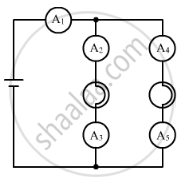
If the lamps are both the same in the figure given below and if A1 reads 0.50 A, what do A2, A3, A4 and A5 read?
Ten bulbs are connected in a series circuit to a power supply line. Ten identical bulbs are connected in a parallel circuit to an identical power supply line.
- Which circuit would have the highest voltage across each bulb?
- In which circuit would the bulbs be brighter?
- In which circuit, if one bulb blows out, all others will stop glowing?
- Which circuit would have less current in it?
Which of the following represents voltage?
The flow of electric charge per unit time is called potential difference.
What is the rate at which charges flow past a point on a circuit?
